

You Pay. They Don’t. Same IRS.
A Treasury watchdog found 215,000 federal employees owe $2.1B in back taxes, including 122 who skipped eight years of filing. Your family pays. They don’t.


You know the drill, mama.
You file on time because you have to. Because if you do not, the IRS has a whole filing cabinet of consequences with your name already on it. Five percent of what you owe for every month your return is late. Another half a percent every month you do not pay. Interest stacked on top of that, and then interest on the penalties, because of course there is. Miss enough and a lien shows up. Then a final notice. Then a levy that can take fifteen percent of somebody’s paycheck and keep taking it until the bill is settled.
You have lived close enough to that edge to know it is not a threat on paper. It is real. One busted transmission, one ER copay, one paycheck that does not land when it was supposed to, and the math gets ugly fast. So you file. On time. Every year. Because that is what playing by the rules costs.
Now set your coffee down for this part.
While families like yours scramble to get it right, about 215,000 federal employees did not bother to pay their federal taxes. As of 2024, that is 6.9 percent of the entire federal workforce sitting delinquent on back taxes, the very taxes their paychecks depend on. These federal workers owe roughly 2.1 billion dollars in unpaid taxes. Add in federal retirees and the count climbs past 571,000 people owing about 6.3 billion.
And it is not getting better. It is getting worse on purpose. The number of delinquent federal workers jumped about 45 percent since 2021, while the federal workforce itself grew only about 4 percent. Around 50,000 of them did not file a return for two or more years. This is not a rounding error. This is a habit.
Now, somebody is going to tell you federal workers are actually more compliant than the rest of us, and on the raw numbers that is true. But that was never the point. The point is not that the government cheats more than your neighbors. It is that the house that writes the rules and bills your family for breaking them should not get a softer scale than the people paying for it. More compliant than average is a low bar for the people who run the place.
Here is the line that ought to stick in your throat. Investigators found 122 federal employees who went eight years or longer without filing a single return. Eight years. And as of last October, not one of them had been referred to IRS Criminal Investigation. The watchdog finally had to make the referrals itself, because the agency that bills your family for being one day late could not be bothered to chase eight years of silence on its own payroll.
A false balance is abomination to the LORD: but a just weight is his delight (Proverbs 11:1, KJV). There is no plainer description of what is broken here. One scale for the family on Main Street. A softer, slower one for the employee on the federal payroll.
So here is the question worth a whole cup of coffee: if the government can find a late payment buried in your family budget, why can it not find eight years of unfiled returns sitting in its own files?
The data already exists. It has existed since 1993. What is missing is not information. It is will. So let me pour you a full cup and walk you through the receipts.
Capitol Cappuccino: the receipts on federal tax delinquency
This all comes from one document, and I want you to have the number so you can look it up yourself. It is a Treasury Inspector General report titled Federal Employee and Retiree Trends Show Increased Tax Noncompliance, report number 2026-3S0-023, issued May 6, 2026. The watchdog said plainly why it wrote it: if ordinary taxpayers learn that federal employees are not paying on time, it may chip away at everyone else’s willingness to comply. They are not wrong about that.
The trend, in plain numbers. Here is the federal civilian employee delinquency, year by year. Watch it climb.
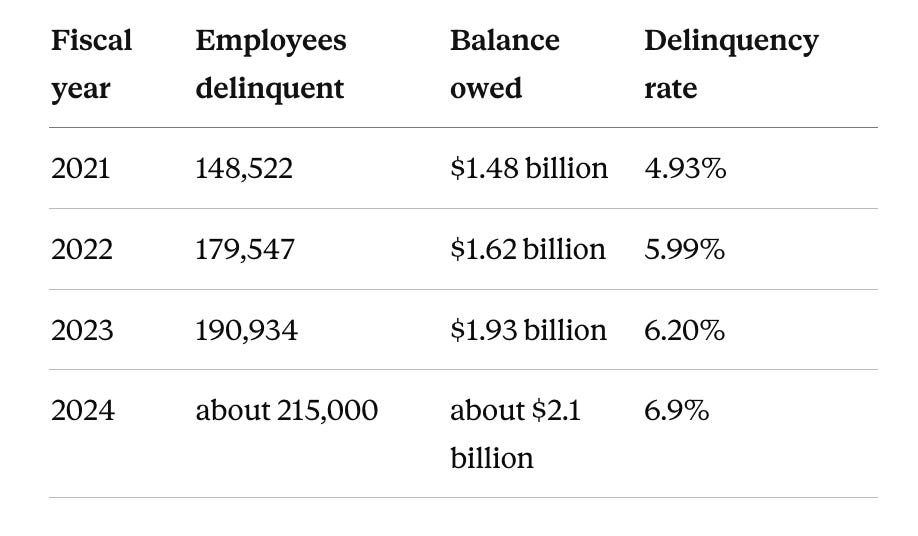
That is more than 66,000 additional delinquent employees in three years, and more than 664 million dollars in fresh unpaid balances, during a stretch when the workforce barely grew. The direction is the story.
Who the worst offenders are. The most recent full agency-by-agency breakdown the government has actually released publicly is from 2023, and it tells you exactly where the problem concentrates. These are 2023 figures, because, and hold onto this, the line-by-line 2024 numbers still have not been made public.
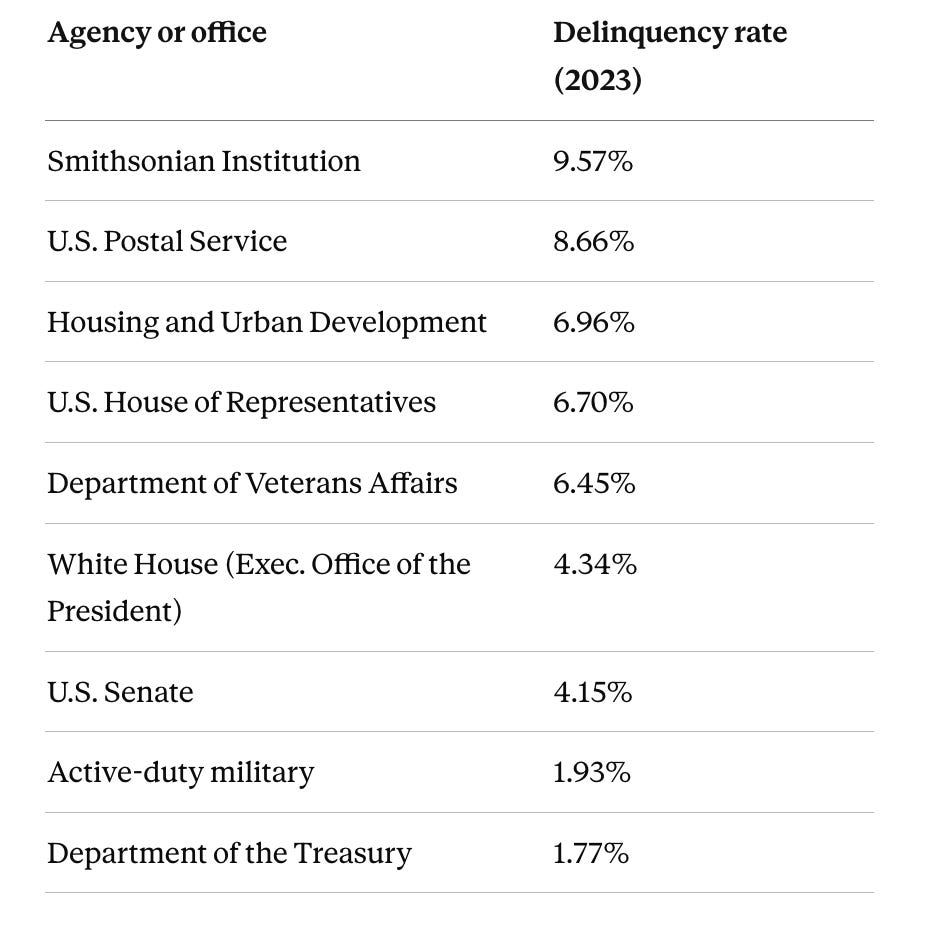
Look at the bottom two lines, because they hold the whole secret.
Why Treasury is so low, and everyone else is not. There is a law, Section 6103, that keeps the IRS from telling most agencies which of their own employees are tax delinquent. It was written to protect taxpayer privacy, and that part is genuinely good. But it also means the agency that signs the delinquent worker’s paycheck usually cannot do a thing about it. The one big exception is the Treasury Department, which is allowed to hold its own people accountable. And look what happens when accountability is permitted: Treasury sits at 1.77 percent while the rest of the government drifts up past six and nine. When somebody is allowed to enforce the rule, the rule gets followed. When nobody is, you get the Smithsonian at nearly ten percent.
It gets worse from there. Between January and July of 2025, the IRS cut the number of staff working these delinquent cases roughly in half, from 242 people down to 121. At the exact moment the problem was growing fastest, Washington halved the crew assigned to fix it. The agency did mail out about 427,000 notices in May 2025, then told the watchdog it considered that a one-time event and did not plan to repeat it. One letter, then back to drift.
And the fix was already on the table. Back in 2023, the watchdog told the IRS to work with Treasury on a narrow change to Section 6103, just enough to let agencies hold their own delinquent employees accountable the way Treasury already can. The IRS passed it up to Treasury’s Office of Tax Policy. Treasury’s response, by the watchdog’s own account, was nothing. No feedback. No guidance. Silence. The recommendation went up the stairs and into the attic, and that is roughly where it still sits.
Now look at the other side of the ledger, the one with your name on it. For Tax Year 2022, returns claiming the Earned Income Tax Credit, the credit working families count on, were examined at about three to seven times the rate of middle and upper-middle income returns. Some of that is because the program has a high error rate, and the IRS will tell you so. But that is exactly the point about speed and burden. The National Taxpayer Advocate found that in one recent year it took an average of 340 days to finish an audit of a taxpayer earning under 50,000 dollars. So the family of modest means meets the IRS not with a friendly phone call but with a yearlong paper chase, while eight years of federal nonfiling sat untouched. Whatever the reason for the flag, the burden lands hardest on the people who can least afford to carry it.
That is the whole story in one sentence. The system moves fast for the family that can least afford the fight and drifts for the insider who can most afford to know better.
Render therefore to all their dues: tribute to whom tribute is due (Romans 13:7, KJV). Scripture does not carve out an exception for government employees. Neither should the IRS.
What they have not told you, and what you can do
A couple of things are still missing from the public record, and they are worth naming, because the gaps are part of the problem. The full agency-by-agency numbers for 2024 have not been released, so we are still working off 2023 to see where the rot is worst. And nobody has said how much that one-time batch of 427,000 notices actually collected. You are entitled to both answers. They are your government and your money.
So here is what you can actually do, and it does not require being a tax lawyer. It requires asking the right people the right question in writing.
Your members of Congress sit on the committees that oversee the IRS. The ask is simple: Will you support amending Section 6103 so federal agencies can hold their own tax-delinquent employees accountable, the same way Treasury already does? And will you demand the full 2024 agency-by-agency delinquency data be released to the public?
Here is a script you can copy into an email or read over the phone in under a minute:
I am a constituent and a taxpayer. The Treasury watchdog reported that 215,000 federal employees are delinquent on their federal taxes, including 122 who went eight or more years without filing, and none were referred for criminal review until the watchdog forced it. My family files on time because we have to. I am asking you to support amending Section 6103 so agencies can hold their own employees accountable, and to demand the full 2024 delinquency data be released. Will you do that?
That is it. No outrage required. Just a just weight, asked for plainly.
Because character is not something we only teach our children at the kitchen table. It is something we have every right to expect from the people we pay to run the place.
If this put words to something you already felt, share it. Send it to the friend who files on time and wonders why it never seems to matter. That is how a kitchen-table truth travels.
And if you want to keep work like this coming, the receipts pulled, the report numbers checked, the script written so you do not have to, you can support it for about the price of a cup of coffee a month. Free will always be free here. The coffee fund just keeps the lights on.
Peace in the chaos. Grounded in Christ and way too much coffee. ☕ Rebekah Winter Haven, Florida. At the kitchen table. Obviously.
P.S. Want the next breakdown the minute it drops? Subscribe free and it lands in your inbox, no paywall, no catch. Just the receipts and a strong cup of coffee.
I used to always get my taxes filed on time except for a couple of years when I filed for an extension. This year, however, I am exhausted and have done nothing yet. I truly believe I am due for a refund, thanks to Trump, I hope I’m right!
It’s quite upsetting to hear that the people collecting our taxes don’t even pay their own!
Unfortunately I am not surprised. But I must say as a Federal Retired employee it makes me actually ill. I have always paid my taxes...even retired. How our government can allow this is scary....and YES I can see many people deciding to just not pay theirs....giving every excuse (like this one about Feds) they can possibly dig up. No one LIKES paying taxes but I always thought "but people know why we pay them". Guess I was misinformed?