

Turning Activism into a Coordinated Operation: A Conservative Mother’s Case Study
Questioning the “Spontaneous” Protest Narrative

As a conservative mother, I’ve learned to be skeptical when the media labels a disruptive event as a “peaceful protest” or a *“spontaneous” outpouring of anger. Too often, these labels mask the organized operations happening behind the scenes. We’re told crowds “just happen” to form at the right place and time – for example, around a U.S. Immigration and Customs Enforcement (ICE) action – as if by coincidence. In reality, recent events have exposed a high level of planning and coordination among activist networks. What might look like random people with signs is often far from random, and understanding that difference is crucial.
Take the case of recent immigration enforcement protests in Minneapolis. The media initially described “angry protesters” taking to the streets after an ICE-involved shooting. That description invites readers to assume a naturally occurring community reaction. But dig deeper, and a very different picture emerges – one of activists directed via encrypted channels, not just everyday citizens who wandered onto the scene. The portrayal of pure spontaneity quickly falls apart once the facts are examined, revealing a coordinated effort that was deliberate rather than organic.
Evidence of Coordination: Organized Operations in Minneapolis
The Minneapolis incident provides a stark example of how modern technology has turned activism into a coordinated operation. In late January, federal agents from ICE and Border Patrol arrived at a local business (a donut shop) to arrest a wanted illegal immigrant. They were met not by happenstance passersby but by a “rapid response” team of activists who seemed uncannily prepared for their arrival. It turns out these activists were linked via encrypted group chats that updated their every move in real time.
Screenshots of encrypted Signal group messages reveal how activists in Minneapolis tracked and updated each other on federal agents’ movements in real time.
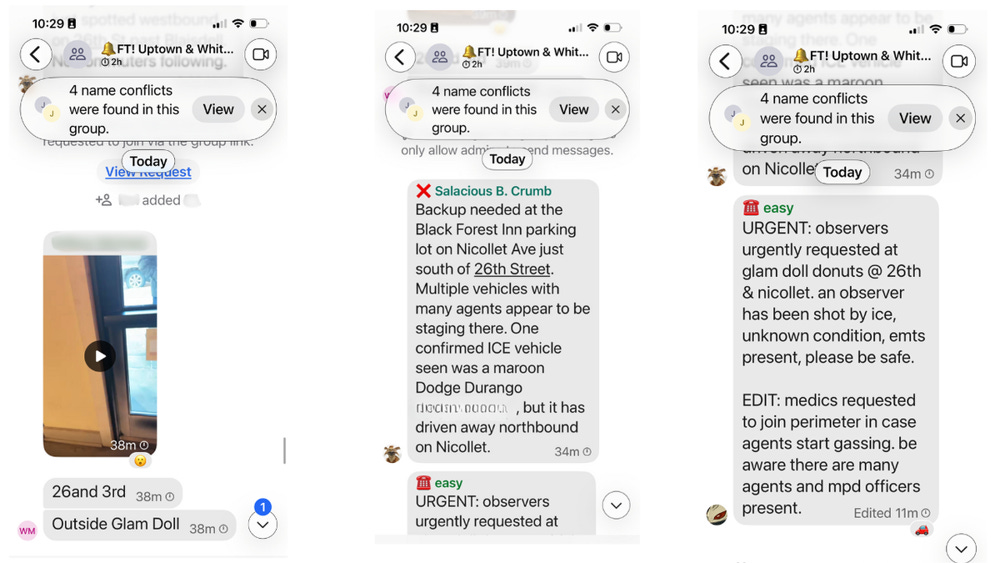
According to a Fox News Digital investigation, activists in Minneapolis used an encrypted Signal chat to broadcast agents’ locations, identify unmarked ICE vehicles, and summon reinforcements on the spot. In a matter of minutes, messages in the group pinpointed exact street intersections and parking lots where agents were seen, even logging license plate numbers of suspected ICE vehicles into a shared database called “MN ICE Plates.” In fact, at least 26 separate entries were made in this database over the course of a single morning, cataloging federal agents’ movements and vehicle details. One entry noted a black Jeep and agents “involved in [the] shooting” at the very location of the fatal encounter – clear evidence that organizers were actively tracking law enforcement activity as it unfolded.
This level of precision is not how genuine grassroots protests operate – it’s how a coordinated mission operates. The activists weren’t merely assembling with signs; they were operating a dispatch system. For example, when agents moved, the group chat instantly redirected protesters to new positions. At 9:50 a.m., one user (“Willow”) posted a video and the message “26 and 3rd… Outside Glam Doll,” alerting others to agents at the donut shop. Three minutes later another user (“Salacious B. Crumb”) sent an urgent call: “Backup needed at the Black Forest Inn parking lot… Many agents… one confirmed ICE vehicle…,” providing a license plate and noting the vehicle’s direction of travel. These aren’t spontaneous reactions – they are real-time tactical updates resembling a police scanner or military operation.
Such coordination wasn’t confined to Minneapolis. Across the country, networks of “ICE Watchers” have emerged, enabled by smartphones and encrypted apps. In major cities like Los Angeles, Chicago, New Orleans – wherever ICE expanded its operations – activists rapidly organized to monitor and confront agents. What began as loose community groups have become increasingly organized response teams. Many participants undergo training on how to monitor law enforcement, record encounters, and alert neighbors. Activist groups have even created websites and smartphone apps to track ICE activity, posting real-time alerts about enforcement operations and offering resources for at-risk immigrants. (Notably, some major app stores have removed these crowd-sourced “ICE tracking” apps, a sign of how far this coordination had gone.) In Minneapolis, the activists’ sophistication was on full display – they effectively had a local intelligence network, complete with an online database and encrypted comms, to counter ICE.
Federal officials acknowledge that none of this was an accident. “This level of engineered chaos is unique,” observed one official, noting it was “not a coincidence” that violence erupted given the “chaos and mayhem” being fomented by agitators on the ground. In the Minneapolis case, the Vice President even described the unrest as “engineered chaos,” pointing to the disciplined logistics behind how quickly socialist and anarchist groups mass-mobilized after the incident. The bottom line is that the protesters knew exactly where to be and when, because they were guided by a coordinated strategy – one that treated the event like a planned operation rather than an unpredictable public protest.
Crossing the Line: Free Speech vs. Illegal Interference
It’s important to state clearly: peaceful protest is a protected American right. As citizens, we can observe, voice dissent, and record public officials in the course of their duties – all under the First Amendment. But what we see in these coordinated actions goes far beyond peaceful observation. When activists use encrypted channels to obstruct law enforcement – blocking vehicles, diverting officers, or even physically confronting agents – they are crossing a legal line. Free speech does not give anyone the right to interfere with officers performing lawful duties or to facilitate the escape of suspects.
Even some officials who defend the right to protest have drawn a sharp line. “Peaceful protest is a right protected under the Constitution… But threats, violence, and property damage by criminal actors… will not be tolerated,” said Mark Zito, a Homeland Security special agent in charge, after a spate of clashes in Omaha. The distinction he makes is critical: observation and expression are legal, but “obstructing a lawful operation” or endangering officers is not. In Omaha, Nebraska, for instance, a group of protesters attempted to physically block ICE agents from carrying out a workplace raid in June 2025. Federal authorities arrested four people from that protest, citing that they were caught on video “damaging federal property and threatening to assault federal agents” during the operation. These individuals weren’t merely holding signs—they allegedly broke windows on government vehicles and menaced officers who were executing a warrant. According to ICE’s report, those arrested now face serious felony charges for “assaulting, resisting, opposing, impeding, intimidating, or interfering with a federal officer” in the performance of duties. This is the legal reality: coordinating to interfere with an arrest can lead to federal charges, not to mention the immediate risk of injury or worse.
Specific examples illustrate how protest crossed into illegal obstruction: In Omaha’s case, ICE Acting Director Todd Lyons condemned the protesters’ actions, noting the irony of activists claiming to fight for justice while “attempt[ing] to obstruct a lawful operation” aimed at arresting individuals involved in identity theft. Those activists, he said, “damaged property, threatened federal officers and agents,” all in an effort to stop ICE from detaining suspects who had exploited stolen identities. Likewise in Minneapolis, what began as activists monitoring ICE quickly escalated into direct confrontation – protestors formed human barricades, and in one outrageous incident an agitator allegedly bit off a federal officer’s finger during a skirmish. Another group stalked and even pelted Border Patrol agents with food and spat at them at local gas stations. These are not examples of constitutionally protected speech; they are crimes. The U.S. Attorney General in Minnesota, Pam Bondi, explicitly warned after these incidents that while peaceful protest is sacred, anyone “obstructing, impeding or attacking” federal officers “will be prosecuted”. The First Amendment is not a shield for coordinating interference or violence. It’s one thing to speak out; it’s another to act as an on-the-ground resistance network intentionally hampering law enforcement.
It’s also critical to consider public safety. When activists swarm an active law enforcement scene, the potential for unintended harm skyrockets. In the Minneapolis case, the confrontations culminated in fatal violence: a 37-year-old activist named Alex Pretti was shot and killed during a struggle with officers outside that donut shop. Just a week prior, a woman named Renee Good – described by activists as a “legal observer” – was also shot dead during an ICE enforcement action in the same city. These tragic outcomes underscore that coordinated interference often provokes volatile, dangerous situations. When crowds encircle agents and tensions spiral, someone can get hurt or even killed, whether it’s an activist, a bystander, or an officer. No mother wants to see her community turned into a battleground where federal agents and coordinated protesters are facing off in the streets. We must ask: if these activists hadn’t swarmed the scene – if they had protested lawfully from a safe distance instead of directly interfering – would these deadly confrontations have been avoided? The risks extend beyond the immediate players too; when chaos erupts, everyone nearby is in danger. This is why law enforcement officials nationwide are growing increasingly alarmed by these orchestrated protests and are drawing red lines around what they will tolerate.
Media Narratives and Double Standards
One of the most frustrating aspects, from a conservative perspective, is how differently such events are framed depending on the actors involved. In the Minneapolis incident, many mainstream outlets chose mild terms like “demonstrators” or “angry protesters” to describe the crowds. Coverage focused on their grievances – for example, outrage over the shooting – without delving into how groups organized and directed those crowds. Crucially, outlets like CNN and MSNBC largely failed to mention that openly Marxist and socialist organizations were behind the mobilization. On video feeds you could literally see protesters waving flags and signs of groups like the Freedom Road Socialist Organization or Party for Socialism and Liberation, yet the media avoided those details. By downplaying the ideological coordination, the press left casual viewers with the impression of an organic, people-driven protest, rather than what a U.S. Senator (and others) have called an “insurgency-like” organized operation.
Now imagine, for a moment, if the tables were turned. If conservative activists – say, a network of right-leaning militias or immigration hardliners – were using encrypted apps to track and confront federal agents, how would the media react? Without a doubt, the language would be far harsher. We’ve seen how conservative protests that escalate, even minimally, get labeled with terms like “extremism,” “domestic terrorists,” or “insurrection” in the press. For instance, federal authorities themselves ended up describing the left-wing New York group of court-watchers (who coordinated to monitor ICE in courthouses) as “anarchist violent extremist actors,” according to internal FBI records. If the FBI is using such terms, one can only imagine the outcry if the subjects were conservative. There’s a palpable double standard: activities from the far-left often get sanitized as ‘community activism’, whereas any analogous tactics on the right would be slammed as dangerous vigilantism or worse.
Even some public officials exhibit this double standard. In Minnesota, after Renee Good’s death, the state’s Attorney General Keith Ellison described her as a “compassionate neighbor” and a “legal observer” who was merely trying to watch out for immigrants. This characterization makes it sound as if she was randomly in the area keeping an eye on things – omitting any mention that she was part of an organized “ICE Watch” network with whistles in hand to alarm others. Contrast that portrayal with how officials speak of conservative protesters who interfere with federal business: there is typically far less sympathy and far more swift condemnation. The media’s reluctance to highlight the organized, radical nature of these left-wing networks contributes to public confusion. Viewers at home might not realize that what’s happening in these ICE protest hotspots isn’t a series of unrelated local grievances but rather a nationally coordinated campaign. In fact, Homeland Security Secretary Kristi Noem has explicitly described it as a “coordinated campaign of violence against our law enforcement” fueled by left-wing groups. That stark description barely gets airtime on mainstream networks. But if a conservative official or group were implicated in a “coordinated campaign” against authorities, it would lead the news cycle for days.
The bottom line is that media framing can either illuminate or obscure the truth. As a concerned mother who wants the full picture, I find it alarming that one must turn to independent or conservative outlets to learn that activists maintained a live database of ICE agents’ whereabouts, or that socialist organizations immediately mobilized nationwide after Minneapolis with pre-printed signs and even calls for a “general strike” to “shut down” society in protest. These facts change the perception of the event from a spontaneous cry for justice into a calculated political operation. Unfortunately, many in the media seem to set aside their skepticism when a protest aligns with a left-wing cause, using gentler language and failing to connect the dots publicly. As observers, we have to do that connecting ourselves – recognizing when we’re being presented with a narrative label (“peaceful protest”) versus the more complex reality unfolding on the ground.
Encrypted Apps and Databases: No Safe Haven from Accountability
How are activists pulling off this level of coordination? The answer lies largely in technology – particularly encrypted messaging apps like Signal or private group chats – and savvy use of social media. These tools have empowered protest organizers to communicate instantly and out of public view. In the Minneapolis case, the activists’ Signal group functioned as a real-time command center, and similar encrypted channels have been used in cities across the U.S. by networks often called “ICE Watch” or “Rapid Response” teams. On these apps, users believe their messages are secure from law enforcement scrutiny, which can engender a sense of impunity. Indeed, one might think that plotting in a locked group chat or a disappearing-message app makes them “untouchable.” But that is an illusion – platforms do not make one truly invisible.
Firstly, even encrypted chats can be infiltrated by authorities when those chats are being used to plan illegal acts. A recent example from New York City proves this point. Activists there had a private Signal group for organizing “court watch” teams (volunteers who monitor immigration court proceedings to warn others of ICE presence). They assumed the encryption kept their coordination secret. However, as The Guardian revealed, the FBI managed to access that Signal group’s conversations – likely through an informant or undercover agent – and in an August 2025 report, the FBI labeled the participants “anarchist violent extremist actors”. The Bureau’s joint report (with NYPD) actually quoted content from the supposedly private chat, including discussions where members talked about improving their tactics near federal buildings. This revelation sent a clear message: even on Signal, activist networks can be exposed if their behavior raises red flags. In the Minneapolis scenario, it appears something similar happened: Fox News obtained encrypted messages and even an internal activist database, likely via sources or infiltration, pulling back the curtain on the operation.
Secondly, activists leave digital footprints beyond just chats. The use of a cloud-based spreadsheet (the “MN ICE Plates” database) is a good example – it was essentially an online log of government vehicles and agent sightings. That’s not something you can hide once investigators know to look for it. Similarly, activists often coordinate on mainstream social media in subtler ways (closed Facebook groups, Twitter hashtags, etc.), which are subject to monitoring. In one instance, authorities noted that activists were using a combination of “encrypted chats, whistles, and coordinated efforts” on the ground to disrupt ICE, and some even built phone-tree style alert systems. Major tech platforms have responded when these efforts violate terms of service – for example, by removing apps or maps that live-track ICE agents. But the cat-and-mouse game continues.
The important takeaway is this: Organizers who think digital tools make them invincible are mistaken. Law enforcement is adapting. The Department of Homeland Security has made it a priority to investigate these networks, including looking into their funding and leadership. The fact that FBI and DHS agents are joining these chats (or recruiting insiders from them) demonstrates that encrypted does not mean immune. When activists escalate from speech to potential crimes – like directing mobs to surround officers or damage vehicles – their communications can and will become evidence. And as we’ve discussed, arrests are being made and charges are being brought against those identified. In short, using an app like Signal may keep casual observers or journalists from eavesdropping on activist coordination, but it won’t stop law enforcement from finding out and holding people accountable when lines are crossed.
Consequences for Law Enforcement and Community Safety
What has been the real-world impact of this new style of coordinated activism? In a word: escalation. Federal officers on immigration duty have faced a dramatic surge in confrontations, assaults, and even life-threatening attacks in the past year. The Department of Homeland Security (DHS) has quantified just how dangerous it has become. According to DHS data, ICE agents experienced an unprecedented 3,200% increase in vehicular attacks – i.e., attempts to ram or hit officers with cars – over the past year. That’s not a typo: a 32-fold spike in car attacks. Alongside that, assaults on ICE personnel rose by more than 1,300%, and death threats against ICE officers skyrocketed by 8,000% in the same period. These staggering figures coincided with the resurgence of robust immigration enforcement operations (under the new administration in 2025) and the organized activist response that followed. Put simply, as ICE ramped up arrests of illegal aliens, militant protest activity ramped up against ICE – with officers increasingly finding themselves the targets of violence.
DHS squarely places the blame on what it calls “radical rhetoric by sanctuary politicians” and activist groups for inciting this wave of attacks. For example, after the Minneapolis shooting, the city’s mayor shouted profanities at ICE and told them to get out – rhetoric which DHS officials say “demonizes our law enforcement” and emboldens agitators. Regardless of one’s politics, it’s hard to deny the effect: numerous individuals have taken it upon themselves to “fight” ICE agents in the field. Some have literally turned vehicles into weapons. In Florida, an illegal immigrant in a car reversed and struck an ICE officer during a stop, nearly crushing the agent’s leg. In Minneapolis, an assailant rammed a federal officer’s vehicle into a tree in one incident. In Chicago, two separate incidents saw suspects deliberately try to run down officers with their cars during a major ICE operation (dubbed “Operation Midway Blitz”). These are shocking developments – historically, such direct, violent attacks on immigration agents were relatively rare. Now, dozens of cases are occurring within a single year. ICE reports that from late January 2025 to late January 2026, they recorded 66 vehicular assaults on their officers (versus just 2 in the prior year) and 275 physical assaults (versus 19 the year before). Each of those numbers isn’t just a statistic; it represents real agents – fathers, mothers, neighbors – who were punched, kicked, hit with objects, or put in the crosshairs of a speeding car while trying to do their jobs.
To a mother like me, these figures are deeply unsettling. We rely on law enforcement to keep our communities safe. When a particular branch of law enforcement comes under organized attack, everyone’s safety is jeopardized. Imagine being an ICE agent attempting to detain a known criminal – say, someone with a serious prior conviction – and suddenly you’re swarmed by protesters blocking your path or hurling projectiles. The target you were after might escape in the chaos, remaining on the streets. Your focus gets divided between the suspect and protecting your own life. This breakdown of order doesn’t just harm the officers; it risks letting dangerous individuals slip away. In Omaha, despite protesters’ attempts to interfere, ICE still detained 76 individuals in a single raid – many of whom were using stolen identities. Federal officials pointed out that those identity-theft crimes leave real victims (Americans whose identities were stolen) who deserve justice. “Where is the concern for the justice they deserve?” the ICE director asked of the protesters. It’s a compelling point: by fighting ICE indiscriminately, activists may be undermining justice for victims of crimes and preventing the enforcement of laws that protect our community’s well-being.
The toll of these confrontations also extends to the community in immediate ways. We’ve seen nights of unrest in places like Minneapolis, with hundreds of protesters clashing with agents, tear gas deployed, and multiple arrests of agitators. At one point, protesters even built makeshift barricades out of dumpsters to trap federal vehicles – tactics reminiscent of urban riots, not peaceful rallies. Local businesses and bystanders inevitably suffer when these situations spiral out of control. Consider that these showdowns often happen on public streets: families live in those neighborhoods, children are nearby. The fear and disruption can be profound.
It’s worth noting that activist-driven chaos does not equate to activist “win”. In Minneapolis, after all the mayhem, federal authorities did not retreat; instead, they bolstered their presence. The White House Press Secretary characterized the shooting of Renee Good and the subsequent unrest as “the result of a larger, sinister, left-wing movement… where our brave men and women of federal law enforcement are under organized attack”. Following that, we saw a firm federal stance: the Attorney General and DHS officials vowed to prosecute aggressors and not to back down from enforcing the law. In other words, the government is treating these incidents not as random flare-ups, but as part of a coordinated threat to rule of law. For communities, that means potentially seeing a more forceful law enforcement posture (e.g. federal agents in riot gear, National Guard activation as happened in Nebraska) to ensure operations can proceed. No one wants to see their city turn into a staging ground for showdowns between militant protesters and federal officers. Yet if the coordinated attacks on ICE continue, heightened law enforcement responses will follow – an outcome that could affect any American city where this battle is playing out.
Conclusion: Being Informed vs. Being Manipulated
The story of how a secure messaging app like Signal turned left-wing “activism” into what is effectively a coordinated paramilitary-style operation is a wake-up call. It demonstrates that all is not always as it appears when we read headlines about protests. As a mother and an engaged citizen, I believe it’s crucial to look beyond the labels and ask: Who is organizing this? What is their goal? How are they operating? In the case we examined, what looked, at first blush, like a spontaneous community protest was actually the product of planning by a disciplined network of agitators using 21st-century tools to mobilize instantly and interfere with law enforcement.
Recognizing this reality is the difference between being informed and being manipulated. If we accept every protest portrayal at face value – if we stop thinking at the word “activism” – we risk missing the troubling truth that some protests are not organic expressions of free speech but deliberate campaigns to subvert law enforcement. No matter where one stands politically, we should all demand honesty about such situations. That means acknowledging when a so-called protest crosses the line into orchestrated obstruction, and holding those responsible to account.
From a conservative perspective, it also means calling out the double standards and insisting that law and order not be sacrificed at the altar of political narratives. When coordination leads to confrontation and violence, euphemisms won’t do – we must name it and address it. In the end, ensuring the safety of our officers, our communities, and yes, even peaceful protesters, depends on understanding the tactics at play and refusing to be misled by simplistic narratives. The next time we see a crowd facing off with ICE or any law enforcement, we should all take a closer look at how and why they gathered. Only then can we have an honest conversation about activism, safety, and the rule of law in our country.
Sources:
Fox News Digital – Far-left network mobilized before and after deadly Minneapolis shooting
Fox News – DHS reports unprecedented surge in attacks on ICE agents
The National Desk – ICE Watchers networks across U.S.
Guardian – FBI spied on Signal chat of immigration activists
WOWT 6 News Omaha – ICE arrests protesters in Omaha raid
Fox News – Homeland Security officials and Minneapolis unrest