

Permission Slip for a Protest
Chicago Public Schools did not just teach civics on May 1. It built a taxpayer-funded runway for children to enter someone else’s political movement.

I love me a good rally. Truly. I’ve led them, attended them, and hauled my babies to most of them.
I have stood at the Florida State Capitol on medical freedom with one of my boys propped on my hip. I have marched for school choice in heels that were absolutely the wrong shoe for the distance. I have shown up on human trafficking, on parental rights, on more bills than I can count, including a handful I helped draft. There is something powerful about gathering with people who refuse to stay quiet about what they believe. That right to assemble is not a footnote in this country. It is one of the bones the whole thing is built on.
When my oldest was little, someone asked him what his mom does for a living. He looked up, completely matter-of-fact, and said, “Rallies. She does rallies.”
So please understand. This is not a piece against rallies. This is not a piece against teaching kids to show up. I actually think kids should attend rallies. I think civic engagement is one of the best things a parent can model. I think the experience of standing in a crowd of people who share your convictions, holding a sign you wrote yourself, watching adults be brave on behalf of an idea, does something to a kid’s soul that no textbook can replicate.
But here is what twenty years of this work and two boys raised in committee hearings has taught me. A rally should be for something. Not against someone.
For medical freedom. For school choice. For the parental right to raise your own child. For the dignity of trafficking victims. For the eight-hour workday, for that matter, since we are on the subject. For is constructive. For names what you are building. Against is just reactive. Against only ever names who you want to lose.
That distinction is not small. Especially when somebody else’s child is being taught it on your dime.
Which is exactly why what Chicago Public Schools did on May 1 is such a betrayal of the thing it claims to be.
What May Day actually was, before it wasn’t
When I was little, May Day meant flowers.
We lived in upstate New York for part of my childhood, and somewhere around the back end of April, the grown-ups would start telling us we had to wait. You can’t pick the little white flowers yet. You can’t pick the Queen Anne’s lace yet. You wait for May Day. And then on May 1, you went out and gathered them, all the tiny white things you had been watching for weeks, lined up in your hand like a promise. You brought them inside. You put them in a little glass on the table. And it meant spring was real now. Not the calendar lie of spring that comes in March. The actual one.
My grandma, who was born in 1909, used to tell me about dancing the maypole. We actually did it a few times, the ribbons in our small slightly-uncoordinated hands, going around in our wobbly little circles. To her, that was May Day. To me, as a child, it was the day spring stopped being a rumor and became a fact.
That is not the May Day the Chicago Teachers Union was invoking on May 1, 2026.
The May Day they were invoking starts in 1886, right here in this country. It begins in Chicago.
In the early 1880s, American workers regularly labored 12 to 16 hours a day. In 1884, the Federation of Organized Trades and Labor Unions set May 1, 1886, as the deadline to win the eight-hour workday. On that date, somewhere between 300,000 and 500,000 American workers walked off the job, with the heaviest concentration in Chicago. Two days later, on May 3, police fired on strikers at the McCormick Reaper Works on Chicago’s Southwest Side, killing several. The next evening, anarchists and labor organizers held a peaceful protest at Haymarket Square. As police moved to disperse the crowd, an unknown person threw a bomb. One officer died instantly. Police opened fire. By the end of the night, seven or eight officers were dead, along with an unknown number of civilians.
Eight anarchists were tried for conspiracy to commit murder, despite no direct evidence linking them to the bomb. Four were hanged on November 11, 1887. One died by suicide in his cell. The rest were eventually pardoned. The “Haymarket Martyrs” became symbols of labor repression worldwide.
In 1889, at the Second International in Paris, delegates declared May 1 an international holiday to honor the dead and continue the fight for the eight-hour day. That is the May Day the CTU is invoking. Not flowers. Not maypoles. Not Queen Anne’s lace in a little glass on the table. That one.
And here is what stays with me. The original Haymarket workers were not children. They did not have permission slips. They were not bused by their school district to a “structured and supervised environment for civic action.” They were adults who risked everything they had, including their lives, to demand basic dignity at work. Four of them paid for the privilege with their necks. Turning their day into a chaperoned elementary school field trip with bagged lunches is not honoring them. It is using them.
What actually happened on May 1, 2026
Here is what they actually did.
On May 1, Chicago Public Schools declared an official “civic day of action.” Schools were technically in session, which is a very useful word, technically. The district had cut a deal with the Chicago Teachers Union to bus students to a downtown May Day rally at Union Park, complete with bagged lunches and district transportation. According to CPS, the district approved roughly 40 field trips for about 2,200 students. The agreement covered 100 schools.
To cover the staff who walked out, CPS deployed more than 2,600 substitute teachers and about 940 substitute support staff personnel. Central office staff had to provide additional coverage at 76 schools. About 13 percent of CPS teachers called out on May 1, more than any other day that week. The district also released 65 additional educators to lobby in Springfield on May 13 and May 27.
The students who attended were not just teenagers. Illinois state law (105 ILCS 5/26-1) only permits an excused civic-event absence for students in grades 6 through 12. For kindergarten through fifth grade, CPS told The 74 directly: “Elementary schools are expected to operate normally, and students are required to attend school as usual.”
But elementary-aged students still ended up at May Day events. Not by claiming a civic absence, since the statute would not have allowed it, but through school-approved field trips. That is the loophole. The civic-absence law would not have authorized fifth graders at Union Park. A “field trip” did.
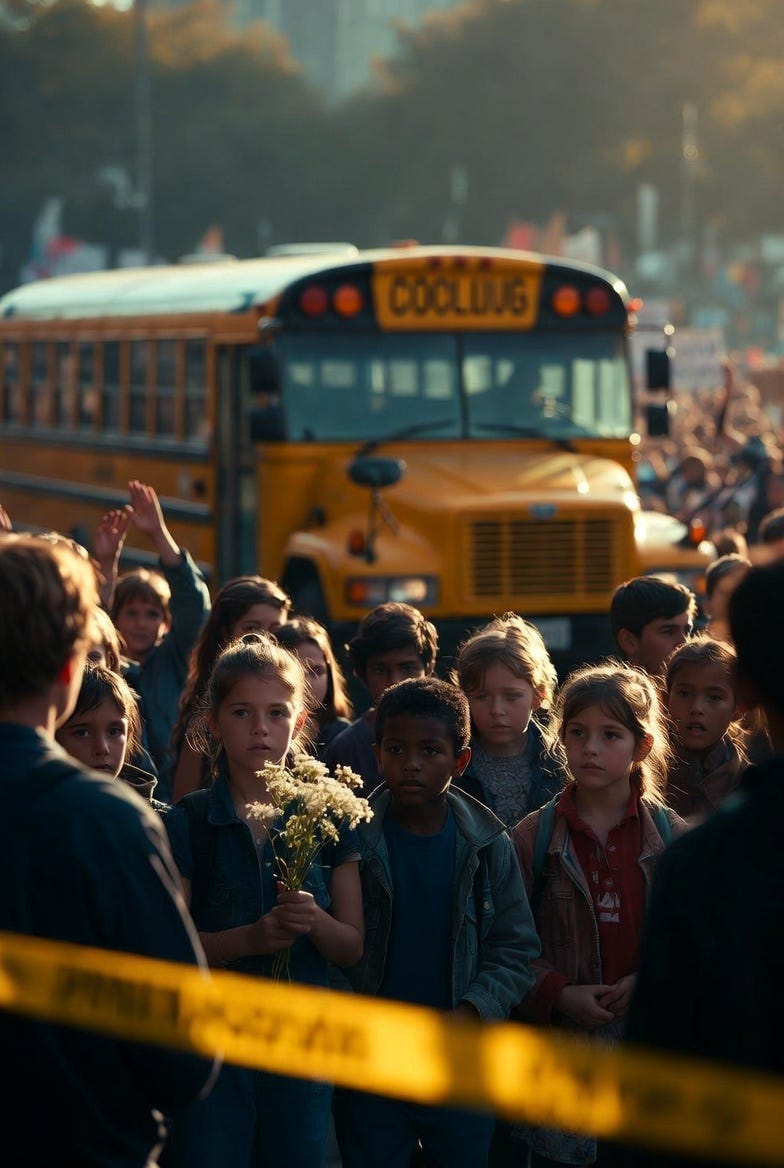
Orozco Academy sent fifth-graders. Beulah Shoesmith Elementary sent half its student population with the principal personally signing off. Funston Elementary brought students who had to be physically fenced off by caution tape at Union Park, with the teacher cheerfully telling reporters that the tape was for “safety.” Burbank Elementary had sixth- through eighth-grade students writing letters to elected officials on homelessness, gun laws, and immigration. Horace Mann Academy sent students. Hancock College Prep brought high school freshmen to Operation PUSH. Kenwood Academy’s eighth grader Corinne Perry was reportedly at the front of the downtown march.
Read those names again. These are not all high schoolers exercising an Illinois-statute right to one civic absence a year. Some are children as young as ten, standing in a crowd of thousands of adult protesters, fenced behind caution tape so their teachers could keep an eye on them. The statute did not authorize their presence. The field trip form did.
The caution tape detail is the part I cannot shake.
And the rally itself was not a labor history lecture. It was an explicit, organized political event. The Chicago Teachers Union’s official resolution declaring May 1 a “Day of Civic Action” called for joining a national “No Work, No School, No Shopping” boycott to “defend our Democracy, demand ICE out of our cities, and tax the rich.” The same resolution called on members to organize “mass resistance training,” and to “reject privatization, illegal wars, union-busting, anti-immigrant and anti-DEI policies, and federal overreach into our classrooms.”
That is the CTU’s language. Not a critic’s framing. Their own resolution, posted on their website, easy to find.
At the rally, Mayor Brandon Johnson (himself a former CTU organizer) thanked CPS students and educators for declaring the day of civic action. CTU President Stacy Davis Gates told the crowd, “In this moment, I am a history teacher that negotiated a civic day of education for all of Chicago’s children to understand the power of workers in solidarity.”
This was a rally against. Not for. Against the federal government. Against Trump. Against ICE. Against deportations. Whatever you think about those positions as an adult, they are against positions. And they were taught to children who never got to choose what the position was.
The price tag
Let’s talk about the math. Specifically, the math that 73 percent of CPS third- through eighth-graders cannot do.
According to the Illinois Report Card released October 30, 2025, only 43 percent of CPS students in grades three through eight read at grade level. Only 27 percent perform math at grade level. Among eleventh graders, 40 percent are proficient in reading and 25 percent in math on the ACT.
That is after the state lowered the cut scores. The Illinois State Board of Education quietly approved lower proficiency benchmarks in August 2025, which means the numbers above are the inflated version. The actual classroom reality is worse.
It gets worse for the kids the district claims to be fighting hardest for. Among low-income CPS students grades three through eight, 35 percent are proficient in reading and 19 percent in math. Among Hispanic CPS eleventh graders, 39 percent are proficient in reading and 22 percent in math on the ACT. Among Black CPS eleventh graders, 25 percent are proficient in reading and 12 percent in math.
Twelve percent.
Then there is attendance. In 2025, 40.1 percent of CPS students were chronically absent, meaning they missed 10 percent or more of the school year. That is 16 points higher than the 2019 pre-pandemic rate. Among Black students, 46 percent are chronically absent. Among Hispanic students, 41 percent. Among low-income students, 44 percent. In Chicago high schools, nearly 50 percent of students are chronically absent.
The adults are not much better. Only 56.8 percent of CPS teachers logged fewer than 10 absences in the 2024-2025 school year. More than two in five Chicago teachers missed at least 10 days. CPS teacher attendance runs nearly ten percentage points lower than the Illinois state average.
Depending on how you count, CPS spends between $22,699 per pupil in current expenditures (per the National Center for Education Statistics) and $28,702 per pupil all-in when you include debt and capital costs. Either number is well above the Illinois state average of $21,776 and far above the national average of $17,619. The FY2026 CPS budget came in at $10.25 billion.
This is the district that found buses, lunches, route plans, substitute coverage, and central-office support for 2,200 children to attend an anti-Trump rally on a Friday afternoon in May. A district where 73 percent of its third- through eighth-graders cannot do grade-level math somehow had the operational capacity to coordinate a 40-field-trip event with hundreds of adult chaperones and political guest speakers.
That is not a resource problem. That is a priorities problem.
The District That Froze Travel Found Buses for a Protest
Here is the part nobody is connecting. Pour yourself a coffee. You will need it.
In November 2025, just six months before May Day, the CPS Office of Inspector General released a special report on district travel. The numbers are not subtle.
CPS spent $7.7 million on staff and student travel in fiscal year 2024, up from $3.6 million in 2019. Total travel spending over six years came to roughly $23.6 million. The report flagged staff trips to Egypt, Finland, Estonia, and South Africa. It found a $20,000 staff trip to Egypt that one elementary school approved with no district sign-off. It found a Las Vegas professional development pipeline where 600 staffers spent more than $1.5 million between 2022 and 2024, with nearly 90 percent of them exceeding CPS hotel limits. It found a teacher who expensed $4,700 for a seven-day Hawaii stay attached to a four-day conference. It found a 2023 college tour approved at $15,000 that actually cost $72,000. It found a South Africa trip for 20 students at $5,200 per student. It found hot air balloon rides, camel rides, and visits to game parks logged as “cultural context activities.”
In response, effective October 29, 2025, CPS froze nearly all employee travel and formed a Travel Review Committee.
Six months later, the same district that had just frozen travel found buses, route planning, lunches, and central-office support for 2,200 children to attend a political rally on a school day. The same district that could not justify a $20,000 Egypt trip apparently had no trouble justifying coordinated transportation for 40 separate field trips to Union Park.
When the Funston Elementary teacher told CBS Chicago that the rally was “a field trip like any other. Why not this and why only the Field Museum? Why only the Shedd Aquarium? Why not this?” she missed the actual question.
The actual question is why a district that just suspended its own travel program because it could not control its own employees suddenly had the operational bandwidth for the most coordinated single-day field trip event of the year. And what they chose to spend that bandwidth on.
And here is the test I would ask any parent reading this to run in your own head.
Imagine a Florida school district decided to make February 14 a districtwide “civic day of action” and bused 2,200 students to a Moms for Liberty rally on the public dime. Imagine the speeches against critical race theory in classrooms, the signs about parental rights, the chants about school choice. Imagine the buses pulling up with district insignia, and the principal saying that any teacher who wanted to could ride along, and the local teachers union calling it civic education.
The same outlets currently writing admiringly about Chicago’s “compromise” would correctly call that what it was. Indoctrination using a captive audience of minors funded by every taxpayer in the district, regardless of their politics.
I would call it that too. Because it is.
Neutrality Is Not Complicity
Here is the part that should give every parent in America pause, regardless of how you vote.
The CTU’s official resolution did not just call for civic engagement. It listed the alternatives it was rejecting. The line reads: “not fear, military assaults, silence, nor complicity, but political education, civic engagement, and school communities prepared to protect one another.”
Silence. Complicity. Those are the words used for not participating.
This is not a slip. This is the explicit framing. Sitting out a partisan rally is described as complicity. Letting kids attend math class on May 1 is reframed as silence in the face of oppression. The neutral position, the option of “we don’t take our students to political protests,” is, in the words of the people running this thing, the wrong moral choice.
Only one Chicago Board of Education member, Jennifer Custer of District 1B on the Northwest Side, publicly and consistently pushed back. Her argument was the simple one. Parents make plans around the school calendar. Stability matters. CPS CEO Dr. Macquline King also opposed canceling classes outright and pushed for the day to stay in session. But Board President Sean Harden (a Mayor Johnson appointee) issued a memo supporting the day of civic action. Even Illinois Governor JB Pritzker, a Democrat, said publicly: “I think we need to make sure that our kids are getting every day of education that they deserve, and that parents demand. Political operators trying to determine what the calendar should be for kids seems inappropriate.”
When the Democratic governor of Illinois is the most cautious adult in the room, you have a problem.
Defenders of the day will tell you participation was voluntary. They are technically right and substantively wrong. The students were optional. The institutional machinery was not. The memorandum of understanding, the buses, the lunches, the substitute coverage, and the central-office support were planned, negotiated, and executed in advance. CPS did not stumble into May Day. CPS built a runway for it.
What the Supreme Court actually said
The constitutional line here is older than the controversy. And it does not say what the Chicago Teachers Union seems to think it says.
In Tinker v. Des Moines (1969), the Supreme Court protected the right of students to wear black armbands to school in protest of the Vietnam War. Students do not, in the Court’s famous phrase, “shed their constitutional rights to freedom of speech or expression at the schoolhouse gate.” That part most people know. It is the part you see quoted on coffee mugs.
What gets quoted less often is Hazelwood School District v. Kuhlmeier (1988). In Hazelwood, the Supreme Court drew a different line. Student speech is one thing. School-sponsored speech is another. Schools can regulate school-sponsored expression, the Court said, including to avoid associating the institution with a position on political controversy. The Court was protecting the school’s right not to be conscripted into a viewpoint.
The Chicago case sits directly on that line. A high school senior choosing to attend a May Day rally on her own time is Tinker. A school district printing field-trip slips, dispatching 40 buses, packing bagged lunches, and providing central-office staff support for elementary-aged children to attend a partisan rally is Hazelwood. The student’s speech is protected. The institutional sponsorship is exactly what the Court said schools have room to regulate, and for good reason. When the school itself shows up at a rally, the school is now part of the rally.
And in the Seventh Circuit, which happens to be Chicago’s, the case law gets even more specific. In Mayer v. Monroe County Community School Corp. (2007), the Seventh Circuit held that teachers do not have a constitutional right to present their personal political views to a captive audience of students contrary to elected officials’ instructions. Public school classrooms are not free-fire zones for adult political preferences. The Seventh Circuit said so. In writing.
Here is the part Chicago Public Schools cannot really walk back. The district’s own published Ethics and Political Activities guidance says civics instruction “should be neutral” and should “examine diverse perspectives without establishing a preferred viewpoint.” It also bars employees from using Board time or Board resources for prohibited political activity, including recruiting students for candidates or referendum positions.
May 1 did not fit the narrowest election-law definition of campaign activity. It did not have to. It violated the spirit of the district’s own published rules about institutional neutrality, using its own buses and its own staff to do it. CPS is not just at odds with parents. CPS is at odds with CPS.
Why parents are watching
The polling on this is more settled than the press coverage suggests, and the numbers are striking.
An Ipsos survey commissioned by ParentsTogether in August 2022 found that 77 percent of parents said classrooms should be places for learning, not political battlegrounds. Seventy-three percent said elected officials and political groups were most responsible for recent disagreements over what is taught. When asked who should have input into curriculum decisions, only 30 percent of parents said state or local elected officials should. Only 10 percent said political groups should. Ten.
A separate NPR/Ipsos poll from May 2023 found 75 percent of K-12 parents trust their child’s teacher to make decisions about classroom curriculum. Only 7 percent said federal legislators and 8 percent said state legislators should be primarily responsible. EdChoice’s 2024 polling found 88 percent of school parents trust teachers, ahead of every other education-decision-making group surveyed.
A 2022 Jack Miller Center/Trafalgar survey found 61.3 percent of respondents already believe public schools are promoting a biased political agenda. A 2025 poll commissioned by The Freedom to Choose Schools found 71 percent of respondents rate U.S. public schools fair or poor. A June 2025 poll found 67 percent of Democrats, 67 percent of Republicans, and 70 percent of independents would cross party lines based on a candidate’s education stance.
The pattern here is not partisan. The pattern is parental. Parents do not trust politicians, political groups, or organized political movements to shape what happens in their kids’ classrooms. They trust teachers. They trust themselves. They want classrooms to be places for learning, not political battlegrounds.
When a school district uses its operational and political capital to bus thousands of minors to an explicit anti-administration rally, with the union openly framing non-participation as complicity, the parents watching will draw conclusions. Some of them already have.
Parents are not asking for much. They are asking for math at grade level. Reading at grade level. A reasonable expectation that when they hand a child to a school bus on a Friday morning, the bus is not driving that child to a political protest.
What this means in Florida and everywhere else
If you are reading this from Florida, you are already doing the math. Our state has parental rights statutes that would make a CPS-style “civic day of action” legally complicated. Probably impossible. Our governor’s race in 2026 is going to turn on questions exactly like this one. What is a school for. Who decides what your child hears on a Friday afternoon in May. The Parent Vote Forum at FPEA on May 22 in Kissimmee will put four candidates on a stage to answer those questions directly. I will be there helping run it.
This story is not just a Chicago story. It is what happens when the people running a school system decide they are activists first and educators second. It is what happens when the moral framework of a teachers union openly redefines neutrality as complicity. It is what happens when “civic education” stops meaning “teaching students how to think” and starts meaning “teaching students what to chant.”
Real civic education teaches a child the difference between speech and orthodoxy. And the actual research backs this up. David Campbell’s widely cited work on “open classroom climate” shows that students build civic competence through respectful classroom discussion of controversial issues, not through institutional sponsorship of a position on those issues. Subsequent peer-reviewed work has linked teaching quality, civic knowledge, and student belonging to civic engagement later in life. The CIRCLE research center at Tufts has reached similar conclusions. What the research does not support, anywhere I can find it, is school-sponsored bus transportation to live political demonstrations as a developmentally effective civic education method.
Real civic education hands a child the actual Haymarket story, the complicated, violent, contested labor mess of it, and lets the kid wrestle. Real civic education makes sure a child can read the Constitution before they get asked to chant a slogan. Real civic education teaches the difference between a viewpoint and a virtue. The difference between assembling for a cause you have chosen and being assembled for a cause somebody else chose for you.
What happened in Chicago is something else. And it is on track to happen again. CPS has already conceded that May 1, 2028, the next time May Day falls on a school day, will be a “teacher-directed professional development day,” meaning students will be off entirely. A “May Day Taskforce” is being created right now to develop curriculum and school-based activities for future years.
The buses will come back. The agenda is already written.
The permission slip
Here is what bothers me most as a mother.
When I take my boys to a rally, I sign the permission slip. I drive the car. I pick the cause. I make the call about what they hear, what they see, what they chant, and what they understand about what they are doing. I make sure the cause is something I can defend to them later, when they are old enough to ask me hard questions. I make sure the rally is for something I believe is worth building, not just against someone I happen to disagree with this season. That is my job. It is one of the most important jobs I have.
When 2,200 children in Chicago boarded buses on May 1, the permission slip was signed by a school district. The chaperones were paid by taxpayers. The destination was chosen by a teachers union. The political content was selected by adults who do not answer to most of those children’s parents, and who explicitly framed neutrality as a moral failing. The cause was not framed in terms of what those children were building. It was framed in terms of who those children were standing against.
That is not civic engagement. That is something else, with a different name.
I will keep going to rallies. I will keep taking my boys. I will keep believing that the right to gather and speak is one of the most beautiful things this country ever handed down. But the next time someone in a school district tells you they are “just teaching civics,” check the permission slip. Check who signed it. Check who chose the destination. Check whether anyone with a different view was on the program.
Check whether the rally is for something. Or only against someone.
And if the answer makes you uneasy, you are not the problem. The permission slip is.
Share this with a parent, a teacher, or a friend who needs to know what “civic day of action” actually looked like up close.
If Courage & Caffeine is the kind of writing you want to keep showing up in your inbox, founding member support is what keeps the buses running the other direction. We are 28 paid subscribers away from our goal of 100 more by May 31, and every founding member matters.
Peace in the chaos. Grounded in Christ and way too much coffee. ☕
Rebekah
Winter Haven, Florida.
At the kitchen table. Obviously.
in 2018 Lisa Miller accompanied a paid-by-the-left bunch of skipping kids to Tallahassee to invade the Capitol and demand Red Flag Laws....our Republican legislature, under that pressure, passed it.
We are now one of two states in the union with Red Flag laws, our legislature will not touch it or reform it...Judd supports it and PCSO is the largest Red Flag issuer in Florida...by far