


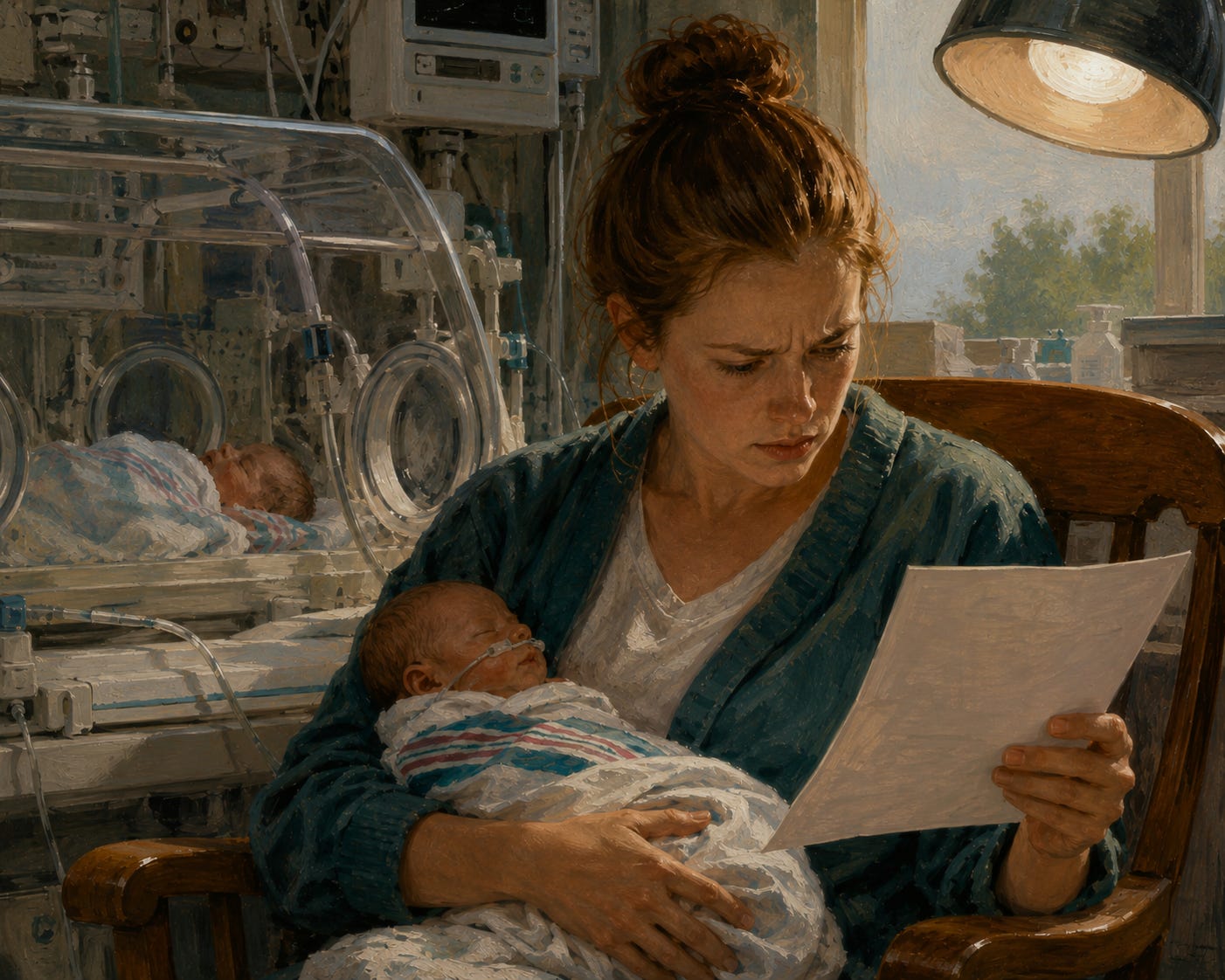
Picture the mother sitting beside an baby in a NICU, watching a two-pound daughter breathe on a ventilator. That baby cannot speak for herself, cannot check a box, cannot withdraw a consent, cannot argue that her life has worth. Hold her in your mind, because everything that follows is a debate about who gets to decide what a life like hers is worth.
In October of 2021, a Kentucky family faced the hardest decision a family ever faces. Their boy, TJ Hoover, thirty-three, had overdosed, and a doctor declared him brain dead. His sister Donna signed the donation papers, believing the worst had already come and gone.
Then they wheeled him toward the operating room, and TJ woke up.
He was thrashing on the bed. His eyes were open and following the people moving around him. He was crying and reaching for the tube in his throat while a team prepared to remove his organs. The federal report logged it in clinical shorthand, purposeful movement to pain. Strip the jargon and it means he was hurting and responding the way a conscious man responds. A former staffer named Nycki Martin could not live with what she witnessed, and it was her account that eventually put this in front of Congress. Donna said she knew in her heart of hearts that he was still in there. She was right. He is alive today.
And TJ was not a fluke.
The numbers nobody wanted read out loud
On July 21, 2025, the Department of Health and Human Services disclosed what federal investigators found when they reviewed 351 authorized donation cases at that one organization. They flagged 103 as troubling. Seventy-three involved patients showing neurological signs incompatible with organ donation. In at least 28 cases, the patient may not have been deceased when procurement was initiated. In one three-month stretch, roughly one in five people wheeled toward that operating room landed in the troubling column.
The case files are worse than the summary. One from December of 2022 describes a patient with watering eyes who began to move around, and who died three days later. Another describes staff pursuing donation consent from a cognitively impaired person the report itself called child-like. I read that and thought about every vulnerable soul who has ever needed somebody else to be the grown-up in the room.
Congress took it up the next day, July 22, 2025, at a House Energy and Commerce oversight hearing. Representative Neal Dunn said the facts seemed more fitting for a horror movie than a congressional hearing. Representative Gary Palmer said the quiet part out loud, that taking a patient’s organs before they die is euthanasia. By September, committee leaders had sent a bipartisan letter to HRSA demanding answers, HHS had moved to decertify the South Florida procurement organization, and by January of 2026 CMS had selected a replacement.
Ordinary people noticed too. The Associated Press reported donor registry removals running around 170 a day after the story broke, roughly ten times the prior year. In Kentucky, where 200 to 300 people typically remove themselves in October, almost 1,100 did. In Arizona, more than 2,500 pulled their names in a single month, over 600 percent above the same month in 2024. Folks voted with their pens.
And this was the moment they picked
Here is why I am writing this today and not a year ago.
That federal disclosure and that hearing happened almost exactly one year ago this week. Then, two weeks back, on July 8, 2026, three bioethicists published a proposal in the New England Journal of Medicine to loosen the one rule standing between a living patient and the scalpel. Yesterday the Wall Street Journal opinion page ran a piece arguing Congress should shut this door before it opens.
So here we are, in the anniversary week of the worst organ procurement scandal in modern American memory, and the answer coming out of a corner of the bioethics world is a paper arguing the rule should bend further. You would think a system caught like that would spend the next decade doing nothing but rebuilding trust.
I read all seven pages so you would not have to.
The paper is “Contextualizing the Dead Donor Rule in an Era of Voluntary Euthanasia” (N Engl J Med 2026;395:194-200), by Dr. Carter Winberg of Harvard’s Center for Bioethics and Western University, Dr. Ian Ball of Western University, and Dr. Robert Truog of Harvard Medical School and Boston Children’s Hospital. That last affiliation is a detail I have not been able to shake.
The dead donor rule is simple. You must be dead before your organs are taken, and the taking cannot be the thing that kills you. These authors argue that where voluntary euthanasia is already legal, that rule can be, and I am quoting their word, recontextualized.
Here is the mechanics, because the mechanics are the argument. Hearts and lungs generally must be transplanted within about six hours. A kidney can tolerate 36 to 48. When a patient is given lethal drugs and the team waits for death to be declared, that delay damages organs, and it damages the heart worst of all. So the proposal is to stop waiting. Anesthetize the patient and let the removal of the organs be the cause of death. They call it death by organ donation. The killing and the harvesting become one single act.
Well, isn’t that precious.
This is a staircase, not a stumble
This is not one strange paper from three people having a bad week. It is the latest step in a patient, decade-long project by a small circle.
In 2013, Dr. Truog, Franklin Miller, and Scott Halpern argued in the New England Journal of Medicine that some living patients near death on life support should be allowed to donate. In 2018, Dr. Ball, Robert Sibbald, and Dr. Truog argued that legal euthanasia in Canada had created a new donation pathway. Two of the three names on this year’s paper were on that one. In 2025, bioethicist Lawrence Masek argued in the Journal of Medical Ethics that if a physician may sometimes cause death while relieving pain, he may sometimes cause death while fulfilling a patient’s wish to donate a vital organ, leaning on comparisons to partial liver donation and fetal surgery to get there.
That same year, a New York Times essay by physicians Sandeep Jauhar, Snehal Patel, and Deane Smith argued donor organs are too rare and that the definition of brain death should be broadened to include irreversibly comatose patients on life support.
Put the pattern together. Every time transplant logistics run into an ethical wall, a certain kind of expert recommends we move the wall. That dog won’t hunt with me, and I suspect it won’t hunt with you.
Their case, and then mine
Let me state their case fairly, and then let me be perfectly clear about mine.
Their argument runs like this. If a grown adult has already chosen a legal death, forcing them into a method that wastes their organs is the state overriding a personal decision. Dr. Truog describes these patients as making a generous, altruistic choice. Johns Hopkins bioethicist Ruth Faden said publicly that the idea is not as disturbing as it first appears if autonomy and informed consent are taken seriously.
The shortage behind it is real. More than 108,000 Americans were waiting for an organ as of April 2026, with another person added roughly every seven minutes. And the system is not failing at volume. UNOS counted 49,064 transplants in 2025, an all-time record, up from 48,149 the year before. More lives saved than ever, and still nowhere near enough. I have loved people on that list. I have prayed over that list.
But I do not accept the premise underneath the whole argument. I am pro-life, and I mean all of it, the unborn and the elderly, the prisoner and the addict, the baby in the isolette and the man everyone has already written off. I am not for assisted suicide. Not as mercy, and not as a gift wrapped in somebody else’s rescue. Every life belongs to God long before it belongs to a committee, a clipboard, or a waiting list, and no life becomes more valuable the moment it becomes useful to somebody else.
Which means my argument with these men starts long before anybody reaches the operating room.
It all rests on one word
Every one of those arguments leans on a single word carrying the weight of a load-bearing wall, and that word is consent.
But you and I know how the donor box actually gets checked. A sixteen-year-old checks it at the DMV between the vision test and a selfie. A worn-out mama checks it renewing her license on her lunch break. Nobody at that counter is handed the fine print.
And here is what the fine print would say. A 2016 study found the standard for declaring brain death varied across 492 different United States hospital policies. The line between alive and gone can shift depending on which building you happen to be wheeled into. Nobody mentions that at the DMV.
The prognosis science is shakier still. Modern neurocritical care literature stresses that outcomes in coma and disorders of consciousness stay genuinely uncertain for weeks and months after injury. A 2024 study of traumatic brain injury suggested a substantial share of patients who died after life support was withdrawn might have survived, some to at least partial independence, had a different path been chosen. Lainie Friedman Ross, a bioethicist at the University of Rochester, opposes death by organ donation for a reason she refuses to dress up. She calls it murder, consent or no consent.
Their own journals concede the pressure
I wasn’t born yesterday and I wasn’t raised soft, so spare me the sermon about pure, uncoerced choice. This warning is not mine. It is sitting in their own literature.
A 2026 overview in the journal Bioethics cautioned that patients who have chosen assisted death may feel morally obligated to donate, and may feel pressure to follow through because people are waiting for their organs. A 2022 scoping review in the American Journal of Transplantation raised the same alarm, warning that once dying and donating are intertwined, ongoing contact with procurement coordinators can shape whether a patient maintains consent for both.
Read that twice. Those warnings are about competent adults who can still talk, still ask questions, still say stop. If the pressure reaches them, then tell me what exactly protects the patient who cannot object at all. Go back to the isolette. When a system starts weighing a dependent life against the organs it could supply, the first ones to feel the cold draft are always the ones who cannot argue back.
The people who warned us years ago
The disability community sounded this alarm long before it was a headline. Not Dead Yet has opposed assisted suicide and euthanasia for years as a discriminatory practice. The National Council on Disability has documented how routinely medical systems devalue disabled lives through assumptions about dignity, dependence, and burden.
Here is the finding that should stop all of us. The most common reasons people give for choosing assisted death are usually not uncontrolled physical pain. They are loss of autonomy, reduced ability to do the things they once enjoyed, loss of dignity, loss of bodily control, and the fear of being a burden on the people they love. Now lay an organ shortage on top of that culture and tell me it sends no message.
Not hypothetical, and not far away
Organ donation tied to assisted death is already established practice in Belgium, Canada, the Netherlands, and Spain, with Australia now documenting real cases, including a widely covered world-first involving a self-administered lethal dose followed by donation of lungs, kidneys, a heart valve, and eye tissue.
In Canada, the national data are the clearest picture of scale we have. In 2025, five percent of all organ transplants used organs donated following medical assistance in dying, and eight percent of deceased donors donated following MAID.
And then there is the case I cannot shake. Secondary reporting describes a sixteen-year-old Belgian girl with a brain tumor who was euthanized and donated her organs, in a process that reportedly stretched some 36 hours from initiation to the final injection so organ assessment and recipient matching could be completed. I hold that one carefully, because the primary clinical record is not readily accessible and much of what circulates is summary and advocacy. But it lands the way it lands, because it sounds exactly like the thing we were once promised could never happen.
I keep coming back to the verse I have whispered over cribs and hospital beds alike. “For thou hast possessed my reins: thou hast covered me in my mother’s womb. I will praise thee; for I am fearfully and wonderfully made” (Psalm 139:13-14, KJV). The One who wrote that attached no quality-of-life clause. He did not say fearfully and wonderfully made right up until a committee decides the organs are needed elsewhere.
Let me be square with you
You deserve the truth and not a scare, so hear this clearly. Death by organ donation is not legal in the United States. It is not a bill in a committee, and it is not under active consideration at the national transplant-system level. Federal law cuts the other way. The Assisted Suicide Funding Restriction Act of 1997 bars federal dollars from being used to cause or assist a suicide or mercy killing, and the National Organ Transplant Act forbids transferring a human organ for valuable consideration.
As it stands, this is an idea in a journal, floated by serious people to see how cold the water is. That is precisely why I am writing about it now, while it is still a sentence in an abstract and not a line in a statute. The time to say no is before the idea takes off its lab coat and puts on a legislative suit.
I am not against organ donation. Real donation, the kind that follows a real and settled death, is one of the most generous gifts a grieving family can ever give, and I honor it with my whole heart. So please do not go rip your name off that registry tonight. Do the harder, better thing instead. Put your wishes in writing. Name the person you trust to speak for you. Tell them plainly you want every reasonable effort made before anybody starts counting your parts. An informed yes is worth more than a frightened no.
What I stand against is renovating the very moment of death so the definition bends toward the demand. Because the day we let dead quietly mean dead enough is the day that mother beside the isolette, and the rest of us, can no longer be sure of the table.
And if a rule being softened on paper unsettles you, wait until you meet the people already stepping clean over it. Next week I am pulling back the curtain on the global organ trade. Ten thousand kidneys sold on the black market every year. A government credibly accused of killing somewhere between 25,000 and 50,000 prisoners of conscience a year for their organs, while the world studies its shoes. Bring your coffee. You are going to need it.
If this unsettled you the way it has unsettled me, do one small thing before you close the tab. Send it to somebody you love who checked that box without ever reading the fine print.
Peace in the chaos. Grounded in Christ and way too much coffee.
☕ Rebekah, Winter Haven, Florida. At the kitchen table. Obviously.
P.S. In this week’s Capitol Cappuccino, I read the NEJM paper line by line so you do not have to, with the actual language, the names behind the ideas, the numbers the press releases skip clean over, and a short script you can keep in your back pocket for the day your state starts inching down this road. You get the receipts.
As always - well written. This issue is coming at us fast! I live in Illinois- our legislators just passed our own version of MAiD, we are also toying with wording on 1 month post Parton abortion. What I struggle with is end of natural life vs prolonged death/ dying we have the means to allow people to “live” months / years with minimal cognition. I know that sounds hitler-like “useless mouths” but working in healthcare it is hard to see the line of “reasonable” ugh I’m just chatting my thoughts
Thank you, Rebekah.
It is most unfortunate to make a false god out of modern medicine.
Secondly, I find the mental twisting - the justifications for undertaking morally dubious acts- to be most troubling.
Stay strong!