

How PACs Got So Powerful
Everyone blames Citizens United for super PACs. They're wrong. A plain-English history of the rulings that built the system, and the one that could reshape it.

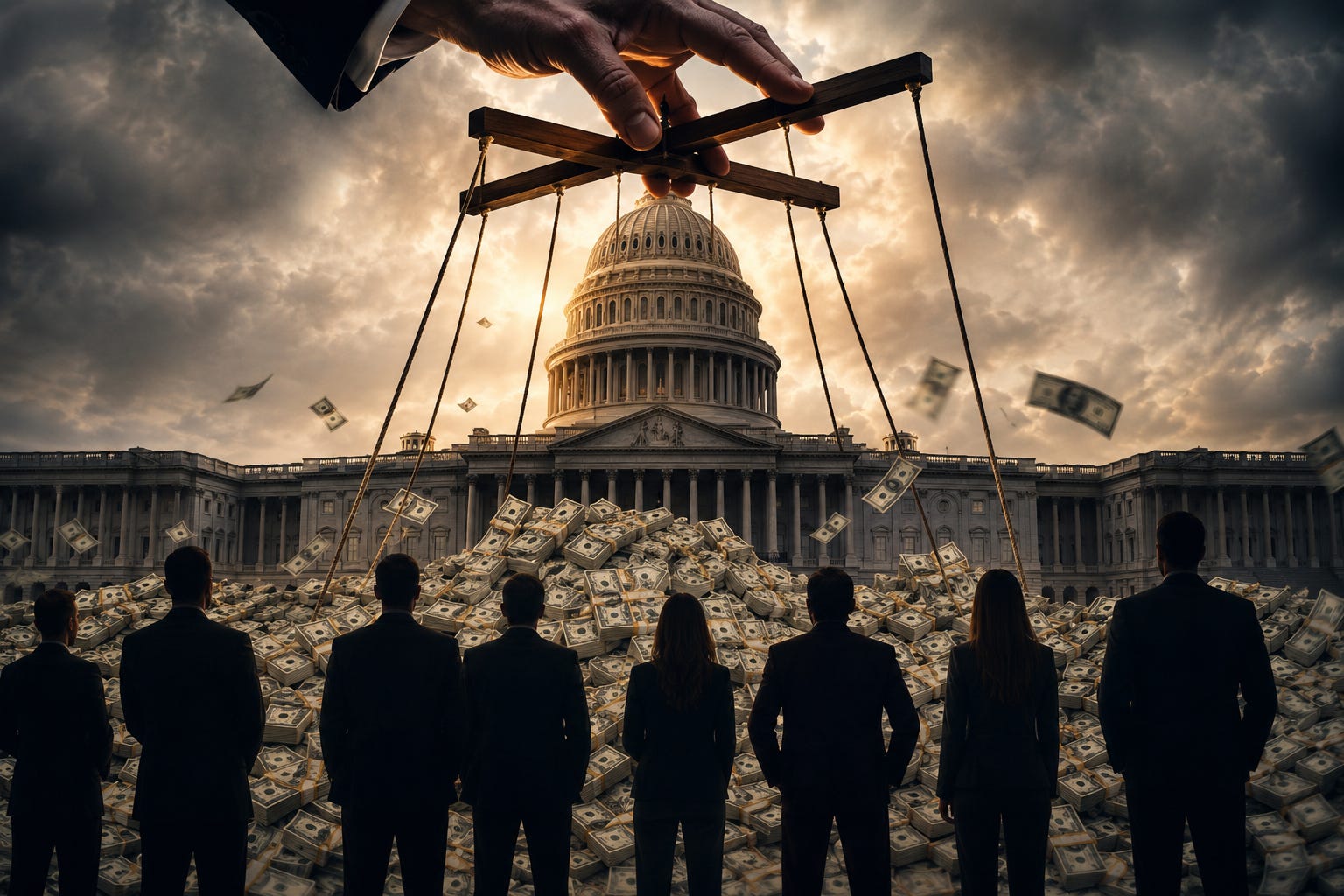
Unpacking PACs, Chapter 3. A Capitol Cappuccino paid edition.
“...men that had understanding of the times, to know what Israel ought to do.” (1 Chronicles 12:32, KJV)
Welcome back to the book. Chapter 1 sorted out what a PAC is. Chapter 2 followed the money down its three roads. Today we answer the question underneath both of those: how did the system get this way, and this powerful, in the first place?
I read the court cases so you do not have to.
The most confident wrong sentence in politics
If you remember one thing from this article, make it this, because it will let you win almost every PAC argument you stumble into between now and November.
Citizens United did not create the super PAC.
I know. Everybody says it did. It is the single most confident wrong sentence in American politics. The super PAC was actually born from a different case, a few months later, that most people have never heard of. We will get there, and when we do you will never hear the Citizens United line the same way again.
But first the part that matters most: none of this came from one switch getting flipped. It got built in stages, over fifty years, one ruling at a time. The men of Issachar understood their times. Let us understand ours.
That is the diagnosis. Here is the whole story.
Capitol Cappuccino subscribers, the rest of the chapter is yours below. This is where the history actually starts.
It started with a scandal and a law
The modern system begins with the Federal Election Campaign Act, FECA, passed in 1971 and toughened after the 1972 campaign scandals through the 1974 amendments. That overhaul did four things at once. It added contribution limits. It added spending limits. It added real disclosure rules. And it created the Federal Election Commission, the FEC, which opened in 1975 to enforce all of it.
Before that, federal campaign finance law technically existed but mostly lived on paper, with weak enforcement and thin disclosure. After it, campaigns and parties and PACs entered a world of registration, reporting, caps, and a referee. That basic architecture still stands today, even after decades of courts chipping pieces off it.
Buckley drew the line everything still runs on
Then in 1976 the Supreme Court decided Buckley v. Valeo, and drew the line that organizes campaign finance to this day.
The Court split the difference. It upheld limits on contributions, money you give to a candidate, because big direct donations can create the reality or the appearance of corruption. But it struck down most limits on expenditures, money spent independently to persuade voters, reasoning that capping political spending caps political speech, since virtually every modern way of reaching people costs money.
Here is the sentence that explains why campaign finance law looks like a plumbing diagram drawn by lawyers: Buckley made the route the money takes legally as important as the amount. A dollar given to a candidate is regulated. A dollar spent independently is protected. Almost everything that came later is just consequences of that one split.
BCRA tried to plug the holes
By 2002, party “soft money” and election-season issue ads had become the big workaround, so Congress passed the Bipartisan Campaign Reform Act, better known as McCain-Feingold. It cracked down on national parties raising money outside federal limits, and it barred corporations and unions from using treasury funds for certain broadcast ads naming a candidate close to an election.
It did not end election money. It redirected it. And it set up the exact legal target that deregulation lawyers spent the next decade aiming at.
2010: the year everybody remembers wrong
Now the famous one. In January 2010, Citizens United v. FEC held that the government may not ban corporations and unions from spending their own treasury money on independent ads supporting or opposing candidates. The majority framed it as a free-speech rule against silencing a speaker because of its corporate identity. The dissent warned about a democracy where people believe laws are bought and sold.
But read carefully what Citizens United actually did. It freed up independent spending. It did not, repeat did not, let corporations write checks straight to candidates. Federal law still bars corporate and union treasury money from going into a candidate’s campaign account. So the line you will hear all fall, “corporations can now donate unlimited money directly to candidates because of Citizens United,” is simply false. The real change was unlimited independent spending, not direct giving.
And here is the part that gets skipped entirely. Citizens United did not create the super PAC.
SpeechNow is the actual birth certificate
Two months later, in March 2010, a federal appeals court decided SpeechNow.org v. FEC. The reasoning went like this: if independent spending does not corrupt candidates the way the Supreme Court just said in Citizens United, then the government has no good reason to cap the contributions going into a group that does nothing but independent spending. So the caps on giving to such a group had to fall.
Then the FEC followed up with a formal opinion that year saying an independent-expenditure-only committee could take unlimited money from individuals, corporations, unions, and other committees. That opinion is the operational birth certificate of the super PAC.
So the honest division of labor is this. Citizens United said corporations and unions may spend independently. SpeechNow said you cannot cap the money flowing into a committee that only spends independently. You needed both, but the specific decision that created the unlimited-donation committee, the super PAC itself, was SpeechNow. When you correct someone on this, you are not splitting hairs. You are pointing at the right case.
McCutcheon loosened the donor side
One more. In 2014, McCutcheon v. FEC struck down the aggregate limits, the cap on how much one donor could give in total across all federal candidates and committees in a cycle. It left the base limits to any single candidate in place. The Chief Justice’s opinion said only quid pro quo corruption, or its appearance, can justify these caps, and that mere influence or access is not enough. The dissent answered that when enough money calls the tune, the public gets drowned out.
McCutcheon did not create super PACs. But it let the biggest donors write many more maximum checks to many more candidates, loosening the regulated side of the system for national donor networks.
The timeline, in one glance
1971: FECA enacted. Stronger disclosure, the framework for corporate and union PACs.
1974: FECA amendments. Contribution and spending limits, and the FEC.
1976: Buckley v. Valeo. Upheld contribution limits and disclosure, struck most expenditure limits.
2002: BCRA. Restricted party soft money and certain corporate and union ads.
2010: Citizens United. Corporations and unions may make unlimited independent expenditures.
2010: SpeechNow plus FEC guidance. Unlimited contributions to independent-only committees. The super PAC is born.
2014: McCutcheon. Aggregate donor caps gone, base caps intact.
2025 to 2026: NRSC v. FEC. The next domino.
How big the change actually was
If you want one number that shows the scale of what these rulings unleashed, here it is. Independent expenditures ran about $144 million in 2008. By 2024 they were about $4.21 billion. That is not a nudge. That is a different era. And outside watchdogs pegged dark money at a record near $1.9 billion in the 2024 races. The post-2010 system is not a slightly bigger version of the old one. It is a different country.
The live next chapter
The story is not finished, which is exactly why this matters right now. As I write this, the Supreme Court is sitting on a case called NRSC v. FEC, and it could come down any day.
The question is whether the limits on what a party can spend in coordination with its own candidate are constitutional. Coordinated party spending is its own category, not a contribution and not a fully independent expenditure, and this cycle those limits run from tens of thousands of dollars up past $3.9 million depending on the office and the state.
The case was argued in December 2025, and the lineup was strange. The Justice Department declined to defend the limits, agreeing with the Republican challengers that they should fall, so the Court had to appoint an outside lawyer just to argue the other side. At argument, several of the conservative justices sounded ready to strike the caps, with one openly worried that parties have been left weaker than the super PACs that now dominate. The Chief Justice pressed whether it is even honest to pretend coordinated party spending is not just a contribution by another name. The liberal justices warned that lifting the caps would hand wealthy donors a clean route around the limits, funneling big money to candidates through the party. The court-appointed lawyer warned that if these caps fall, the dominoes keep going, and the Court will end up rebuilding campaign finance law from the ground up.
Back in 2001, a case called Colorado II upheld these caps on the theory that parties can become a pipeline for big donors trying to reach candidates. The challengers say that logic cannot survive after Citizens United and McCutcheon narrowed what even counts as corruption. As of this writing, the case is still undecided.
If the Court sides with the challengers, it will not abolish super PACs. It could do something arguably bigger: give parties a candidate-linked channel for unlimited money, the very thing the law has spent fifty years trying to wall off. That is the next stage of this exact story, possibly landing before the midterms are over. Understanding the times means watching this one closely.
Sorting the noise
Myths to throw out. That Citizens United created super PACs. No, SpeechNow did. That corporations can now give unlimited money straight to candidates. No, treasury money still cannot go to a campaign. That all PACs are the same. No, the whole history is the law inventing new and different categories.
Facts to be honest about. Buckley’s contribution-versus-expenditure split is almost fifty years old and still runs the field. Citizens United and SpeechNow worked together, not interchangeably. And today’s system is looser than what Congress wrote, but it is not lawless. Direct contributions are still capped, treasury money is still barred from candidates, disclosure rules still broadly exist.
The honest debate. Whether coordinated party spending is closer to a protected party’s own speech or closer to a backdoor contribution is a real constitutional fight. The Supreme Court itself is deciding it as you read this. That cannot be filed under misinformation.
A few facts to keep in your back pocket
A corporate or union treasury still cannot legally donate straight to a federal candidate, despite years of rhetoric saying otherwise.
The decision most responsible for the super PAC was not Citizens United. It was the lower-court ruling in SpeechNow, followed by FEC guidance.
Buckley kept contribution limits while throwing out most spending limits, which means the core divide running this whole system is almost half a century old.
In NRSC v. FEC, the federal government refused to defend its own law, so the Supreme Court had to appoint a lawyer to argue for keeping it.
Your election-season cheat sheet
When the Citizens United line comes flying at you this fall, you now have the whole map. Buckley drew the line. Citizens United freed corporate independent spending. SpeechNow built the super PAC. McCutcheon loosened the donor caps. And NRSC may be about to open one more door.
Understanding the times is the whole job. Once you know how it got built, the loudest claims of the season mostly fall apart in your hands.
Next in the book: The Scam PAC Problem
Somewhere in your phone right now is a text begging you for five dollars to save the veterans or stop the radicals. Most of those asks are real. Some are wolves in patriotic clothing, and in real federal cases the operators kept up to ninety percent of what donors gave. Next chapter, how to spot a scam PAC yourself in about five minutes, and why the grift is bipartisan. Bring your skepticism and your good coffee.
Chapter 4 drops next for Capitol Cappuccino subscribers.
If this finally untangled the Citizens United myth for you, send it to the person who keeps repeating it. Correcting that one line is a public service.
Peace in the chaos. Grounded in Christ and way too much coffee. ☕ Rebekah, Winter Haven, Florida. At the kitchen table. Obviously.
P.S. This book is being written in public, chapter by chapter, right here in Capitol Cappuccino. For about a cup of coffee a month you get every chapter first, you keep the whole pot brewing, and you help me finish the thing. Pull up a chair and stay a while.