


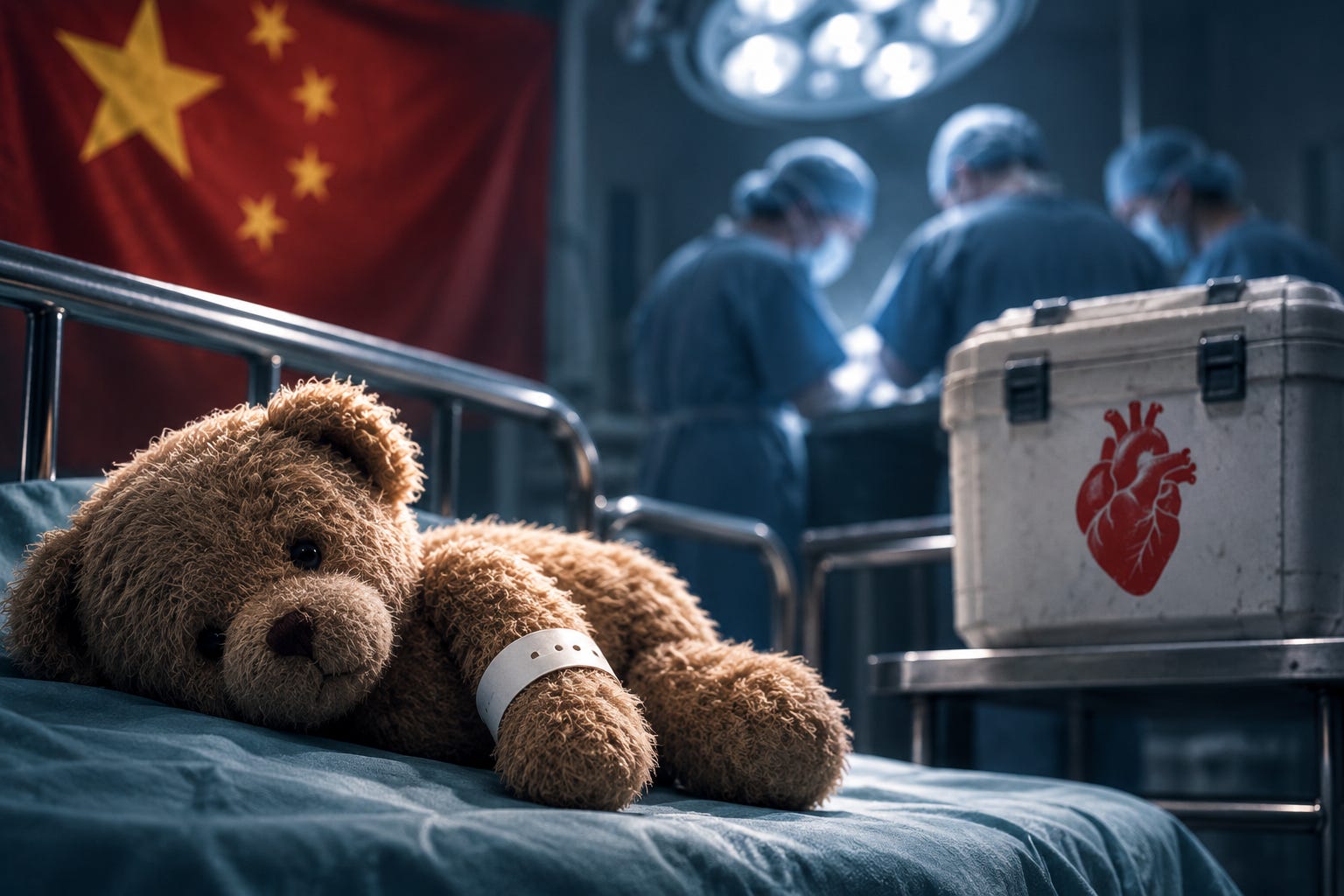
Last week I wrote about three bioethicists who want to soften the oldest safety rule in transplant medicine. The dead donor rule. You must be dead before your organs are taken, and the taking cannot be the thing that kills you.
This week I want to show you what it looks like where that rule was never honored at all. We do not have to imagine it. Two researchers did the forensic work, published it in a peer-reviewed journal, and gave the practice a name.
They called it execution by organ procurement.
What two researchers found in the surgeons’ own paperwork
In April of 2022, Matthew Robertson, then a doctoral researcher at Australian National University, and Dr. Jacob Lavee, director of the Heart Transplantation Unit at Sheba Medical Center in Israel, published a study in the American Journal of Transplantation. They did something nobody had done. They read the surgeons’ own published papers.
They ran computational text analysis across 2,838 transplant papers pulled from a corpus of 124,770 Chinese-language publications, hunting for one specific thing. Descriptions of surgery that could not have happened the way the authors said they did.
You need one piece of medical detail to see what they found. To legitimately declare a person brain dead, you must perform an apnea test. That requires the patient to be intubated and on a ventilator. There is no shortcut and no substitute. It is the whole test.
They found 71 papers, published between 1980 and 2015, describing heart procurements where that test could not have occurred. In some, a face mask was used instead of intubation. In others, a rapid tracheotomy was performed and intubation followed after. And in others, intubation happened only after the sternum had already been cut open, while the surgeons were looking at the beating heart.
Read that again. The chest was opened first.
Their conclusion sits right there in the paper. In these cases, removal of the heart during procurement must have been the proximate cause of the donor’s death. The surgery was the execution.
This was not one rogue hospital. It was 56 hospitals, twelve of them military, across 33 cities in 15 provinces, with 348 surgeons, nurses, anesthesiologists, and other medical workers listed as authors. And when a reporter asked Robertson about the count, he said the thing I have not been able to put down. It is not that there were only 71 of this sort. It is 71 that they found. They could only count what somebody bothered to write up for publication.
So last week, three bioethicists asked whether the dead donor rule might bend. These two researchers already documented what it looks like when it breaks, seventy-one times, in the perpetrators’ own handwriting.
The appointment that gives it away
Dr. Lavee did not come to this as an activist. He came to it as a heart surgeon, because of a patient.
His patient was told he could travel to China in two weeks and receive a heart transplant on a specific date.
Sit with that for one second, because you do not need a medical degree to see the problem. Hearts do not sit on a shelf. A heart becomes available when a particular human being dies under a particular set of conditions, and no one on earth can schedule that. Unless, of course, somebody can.
Lavee asked the only sane question. Who had to die on schedule to keep that appointment?
He has spent the years since building the evidence. This is not a man with a theory. This is a transplant surgeon who was handed a calendar date and understood immediately what it meant.
The American Public Health Association has since summarized reports of Chinese wait times measured in days and weeks, including emergency liver transplants located within three days and hospitals quoting matches inside a week. In the United States, more than 108,000 people were waiting as of April 2026, with another person added roughly every seven minutes. In an honest system, patients wait years. Organs are not booked like dinner reservations.
The man who woke up
Last week I told you about TJ Hoover, the Kentucky man who woke up on the table while a team prepared to take his organs. I need to tell you about another man who woke up.
His name is Cheng Pei Ming. He is a Falun Gong practitioner who was detained repeatedly between 1999 and 2004 and sentenced in 2002 to eight years.
On November 16, 2004, while in custody at Longnan Hospital, he was presented with consent forms and refused to sign them. Six guards held him down and anesthetized him anyway.
He woke up three days later, shackled to the bed, with a long incision down his body.
For years that was simply one prisoner’s account, and I understand why a careful person would want more than an account. Then he escaped, through Thailand, and reached the United States in 2020. American doctors put him through CT imaging. The scans confirmed that segments two and three of his left liver lobe were gone, along with a portion of his left lower lung lobe.
He testified publicly in Washington on August 9, 2024. The British Medical Journal reported on his case that same month. He is believed to be the first known living survivor of forced organ harvesting to get out of China and be examined by Western physicians.
The Chinese Embassy called it sensational lies.
The scans are still the scans. Whatever anybody says about the man, the tissue is missing from his body, and no surgeon ever asked him.
Who is in the inventory
On June 14, 2021, twelve United Nations human rights experts said publicly that they were extremely alarmed by credible information they had received. Detainees from ethnic, linguistic, and religious minorities in China were being subjected to forced blood tests and organ examinations, ultrasounds and x-rays, without informed consent. The results were reportedly stored in a database of living organ sources.
The groups they named: Falun Gong practitioners, Uyghurs, Tibetans, Muslims, and Christians. The organs most commonly reported: hearts, kidneys, livers, corneas.
I want to be precise about what that does and does not prove, because precision is the only thing that makes this survivable to write about. Blood typing and DNA collection are not themselves proof that anyone was harvested. The Congressional-Executive Commission on China put it exactly right when it reviewed leaked Xinjiang police files showing blood-type and DNA collection from large numbers of internees. That data is not proof by itself. It is a necessary precondition for organ matching.
Which is the part that turns my stomach as a mother. You cannot match an organ to a recipient without first knowing the donor’s blood and tissue type. So when a government takes a captive population, catalogs their bodies without consent, files the results, and then tells the world to stop asking questions, no honest parent calls that reassuring.
On the scale of it, Congress has been given grim numbers, and you deserve to know exactly whose numbers they are. In the Congressional Record on May 5, 2025, Rep. Chris Smith cited researcher Ethan Gutmann’s estimate that organs in Xinjiang are being harvested at a rate translating to 25,000 to 50,000 victims annually, and that even the low figure implies roughly 175,000 murdered over a short span. Gutmann builds that from observed annual disappearance rates of about 2.5 to 5 percent among roughly one million detainees, whose average age runs around 28 or 29.
That is an estimate from an outside researcher, cited by a congressman. It is not an audited count, and nobody gets an auditor into those camps. Gutmann further estimates cumulative deaths in Xinjiang above 200,000 and climbing, and notes that at two to three organs per person, a population that size can supply the bulk of a national transplant industry.
But note that age. Not the elderly. Not the sick. Young adults in their physical prime, which is precisely the population you would select for if what you wanted was organs.
Every one of them is somebody’s child. Some mother sat up nights with them when they were small, exactly like you and me.
What Beijing says, and why the arithmetic refuses to cooperate
I will give you their side, because you deserve to weigh it yourself.
Since 2015, the Chinese government has claimed it relies exclusively on voluntary citizen donation and has ended the use of organs from executed prisoners.
Start with what is not in dispute. In 2005, Chinese officials publicly admitted that organs from executed prisoners had long been used for transplantation. Florida’s own legislative analysis of a 2022 measure put the figure at up to 95 percent of Chinese transplants deriving from prisoner executions before the reforms. So the underlying premise here is not conspiracy talk. It is acknowledged history. The only question is whether it stopped.
Here is the wrinkle that same Florida analysis flagged. Chinese officials announced that hospital-based voluntary donation would be the sole source of organs beginning in 2015. No changes to laws or regulations accompanied that announcement.
It was a press release, not a legal reform.
Then there is the data itself. In 2019, BMC Medical Ethics published an analysis by Robertson, Hinde, and Lavee finding that China’s official deceased-donor datasets fit suspiciously smooth mathematical curves, with anomalies suggesting systematic falsification and manipulation. Nature Human Behaviour highlighted the work, noting the official numbers adhered almost exactly to a simple mathematical formula, along with implausible provincial irregularities. Real human death is messy. It does not graph like a textbook parabola.
And then there is the volume, which is where I want you to do the math with me.
Beijing publishes its numbers, and they have improved. By the end of 2025, China reported more than 7.3 million registered voluntary donors, roughly 63,000 to 66,000 cumulative posthumous donation cases, and more than 197,000 donated organs since the program began. For 2025 specifically, official figures show about 6,931 deceased donations and 25,799 transplant surgeries.
Now hold that against what independent investigators have estimated. David Kilgour, David Matas, and Ethan Gutmann put China’s annual transplant volume at 60,000 to 100,000 procedures. Texas legislators cited a range of 60,000 to 90,000 in their own bill analysis.
Even taking Beijing’s own reported figure at face value, the gap between roughly 26,000 official surgeries and the 60,000-plus that investigators observe is not a rounding error. It is tens of thousands of operations a year with no accounted-for donor. And it still does not explain how a hospital promises a stranger a matched heart on a calendar date.
Which brings us to the most authoritative finding on the record. The Independent People’s Tribunal into Forced Organ Harvesting from Prisoners of Conscience in China was chaired by Sir Geoffrey Nice, the man who led the prosecution of Slobodan Milosevic. It delivered its conclusion in June of 2019 and its full judgment in March of 2020. The finding was unanimous and reached beyond reasonable doubt. Forced organ harvesting from prisoners of conscience had been practiced for years on a significant scale. Falun Gong practitioners were one source and probably the main source. The infrastructure had not been dismantled, so the tribunal concluded the practice continued.
Beyond reasonable doubt. That is the criminal standard. That is what we require to put a man in prison for life.
That tribunal is not a court and its judgment is not a conviction. I will not pretend otherwise. But it remains the most comprehensive evidentiary synthesis anyone has assembled, and the honest way to say all of this is that there is credible evidence of state-enabled forced organ harvesting in China. We do not possess an audited ledger of the dead. We do not need one to know what we are looking at.
The market that runs on the poor
The state-run version is the worst of it. It is not all of it.
The World Health Organization has estimated that transplant tourism accounts for roughly 10 percent of global transplantation practices. Global Financial Integrity valued organ trafficking at 840 million to 1.7 billion dollars a year. And the crime is barely detected. A current UN explainer counts at least 175 reported cases of trafficking for organ removal worldwide across about 25 countries between 2017 and 2023, which tells you almost nothing about prevalence and everything about how invisible a crime becomes when it happens inside a hospital.
Follow the money and the exploitation is obvious. A Canadian parliamentary report estimates buyers pay 50,000 to 120,000 dollars for a black market kidney, with some cases reaching 200,000. The person it came out of is typically promised somewhere between 500 and 10,000 dollars, and may never see a penny. The average victim, per the UN Office on Drugs and Crime, is a young man around 30.
They are recruited with lies. That kidneys grow back. That a person has three. That medical care will follow. In Pakistan in 2023, victims were lured with promises of jobs and payouts, and their kidneys sold for around four thousand dollars. Some are made to sign consent forms or falsely declare they are related to the recipient.
In Nepal there is a district they call Kidney Valley. A nineteen-year-old named Santosh left his village looking for migrant work and came home with one kidney. In his words, he can barely walk now, he faints easily, and he cannot lift anything heavy. An estimated 35,000 Nepalis are sold into some form of modern slavery every year.
Santosh is nineteen. Some mother raised that boy and sent him off to find work.
And before anyone tells me this is a faraway problem, look at our own hemisphere. In September of 2025, the Office of the Director of National Intelligence said intelligence supported the arrest in Mexico of Martha Alicia Méndez Aguilar, known as La Diabla, in connection with an alleged cartel-affiliated network that lured pregnant women, performed illegal cesareans, harvested organs from the mothers’ bodies, and sold the newborns. That is an allegation in an active criminal matter, not a conviction, and I will hold it exactly that loosely. But our own intelligence community treats organ-linked atrocity crime as a live threat on this continent.
I have spent years working demand-side trafficking law, and the principle does not change when the commodity does. There is no supply without a buyer. Every kidney cut out of a teenager in South Asia goes into somebody who wrote a check. Every heart taken in a Chinese operating room goes into somebody who booked a flight. You do not end this by lecturing the desperate. You end it by making it financially radioactive to be the customer.
Israel already proved it works
Here is the part that keeps me from despair, and it comes from the same surgeon.
After Dr. Lavee’s patient was offered that scheduled heart, Israel passed its 2008 transplant law. It cut off reimbursement for illegal transplant tourism and paired that with real incentives for domestic donation.
The results were published in the American Journal of Transplantation. Kidney transplants performed abroad by Israelis fell from 155 in 2006 to 35 in 2011. Donation and transplantation at home went up.
So spare me the fatalism that says nothing can be done about human desperation. Something was done. A small country did it, and the demand collapsed, and more of its own citizens got transplants honestly. Cut the money and the market shrinks. It is not a theory anymore.
The bills, and the one that is buried
On May 7, 2025, the House passed the Stop Forced Organ Harvesting Act, H.R. 1503, sponsored by Rep. Chris Smith of New Jersey with Rep. Bill Keating of Massachusetts. It would require the President to name those facilitating forced organ harvesting and impose property-blocking sanctions and visa consequences, amend State Department human rights reporting to cover forced organ harvesting country by country, and authorize passport revocation in related convictions.
It passed 406 to 1.
Four hundred and six to one. In this Congress. On anything.
It reached the Senate on May 8, 2025, was read twice, and was referred to the Committee on Foreign Relations. It has sat there ever since, fourteen months and counting, with no markup and no floor action. The Falun Gong Protection Act, H.R. 1540, sponsored by Rep. Scott Perry, passed the House by voice vote on May 5, 2025 and is parked in the identical committee.
The live vehicle is newer. On March 5, 2026, Senators Ted Cruz of Texas and Jeff Merkley of Oregon introduced S. 4009, the Falun Gong and Victims of Forced Organ Harvesting Protection Act, later joined by Senators Adam Schiff and Todd Young. On June 17, 2026, the Senate Foreign Relations Committee ordered it reported favorably. It cleared committee five weeks ago and is waiting on floor time right now, this month, while you read this.
There is also the BLOCK Act, H.R. 2114, which would bar federal reimbursement for transplants when an organ’s origin cannot be verified through the national procurement network. Its lead sponsor is Rep. Neal Dunn of Florida, joined by Rep. Gus Bilirakis and Rep. John Moolenaar. If Dunn’s name rings a bell, it should. He is the same congressman who sat through last summer’s procurement hearing and said the testimony sounded more fitting for a horror movie than a congressional hearing.
And on May 14, 2026, the Congressional-Executive Commission on China held a hearing titled “A Market Built on Victims: Stopping Illegal Organ Trafficking in China and Beyond.” Chris Smith opened it by noting he has been holding hearings on this for thirty years. He called the practice murder masquerading as medicine, and said the atrocities are getting worse, not better. Among the witnesses was Kalbinur Sidik, a survivor of the Xinjiang camps.
Nobody in Washington can claim they have not been told.
Now the part that is ours
Six states did not wait on Congress.
Texas passed Senate Bill 1040, which bars health benefit plans from covering organ transplants performed in China or in any country known to participate in forced organ harvesting, extends that to post-transplant care, and lets the state health commissioner add countries to the list. Utah, Idaho, Tennessee, and Arkansas enacted their own versions. In May of 2025, Arizona’s End Organ Harvesting Act, sponsored by Rep. Leo Biasiucci, was signed by Governor Katie Hobbs, a Democrat, which should tell you this is not a partisan question anywhere except in the imagination of people who have not read it.
Now, Florida. We are on the record, and I want to be honest about exactly how far that record goes. Florida moved House Memorial 791, which lays out the China Tribunal findings and formally petitions Congress to act.
Read the bill analysis and you find this sentence. Memorials have no force of law.
We wrote Washington a strongly worded letter.
I have helped move forty-some bills across a handful of states, and I know the difference between a resolution and a law with teeth. A memorial is a statement. Texas passed a statute an insurance company has to obey. Both have their place, and I am glad Florida spoke. But no Florida insurance product is currently barred from paying for a transplant obtained in a hospital where the donor never consented and never woke up.
Session is coming. Texas already wrote the model language.
“If thou forbear to deliver them that are drawn unto death, and those that are ready to be slain; If thou sayest, Behold, we knew it not; doth not he that pondereth the heart consider it? and he that keepeth thy soul, doth not he know it? and shall not he render to every man according to his works?” (Proverbs 24:11-12, KJV)
Behold, we knew it not. That is the defense Scripture anticipates and then refuses to accept. The tribunal ruled in 2019. The UN experts spoke in 2021. The forensic study published in 2022. The House voted 406 to 1 in 2025. Nobody gets to say we did not know.
What to actually do
Call both of your United States Senators. Call, do not email. Ask them to press for floor consideration of S. 4009, and ask what they intend to do about H.R. 1503, which has sat in Foreign Relations for fourteen months after passing the House 406 to 1. You do not need a speech. Two sentences and your zip code.
If you are in Florida, we have homework. Six states passed enforceable laws. We passed a memorial. Ask your state representative and senator whether they will file the insurance bill this session, and tell them the model language already exists in Texas.
And when you talk about this, lead with the primary sources. The China Tribunal judgment. The June 2021 UN statement. The Robertson and Lavee study. The bill text. This subject attracts wild rumors, and the documented record is so much worse than the rumors that we never have to reach for them.
Last week they asked whether the rule should bend. This week we looked at the people who broke it, at the paperwork they left behind, and at two bills sitting in one committee waiting on somebody to care.
If this made you angry, good. Send it to one person who will carry it further.
Peace in the chaos. Grounded in Christ and way too much coffee. ☕
Rebekah, Winter Haven, Florida. At the kitchen table. Obviously.
P.S. In this week’s Capitol Cappuccino, I break down S. 4009, H.R. 1503, and the BLOCK Act side by side. What each one actually does, who is sponsoring and who is stalling, the state laws already on the books with their bill numbers, the Texas model language a Florida bill could be built from, and the call script. You get the receipts.
Nice research and analysis. Many thanks!
Read the book Killed to Order by Jan Jekielek. If the article you just now read is not enough to convince you that this practice is truly happening, then Killed to Order will. I for one will be making phone calls to my government representatives. Thankyou for supplying the information to do so.