

Case Study: When Bipartisanship Became Breaking News
The data behind why one crossover vote now breaks the internet, and what moms need to know about how Congress actually works

Courage & Caffeine Case Study Series — Policy Deep Dive I read the bills so you don’t have to.
Bipartisanship in modern Congress hasn’t vanished. It’s been demoted from “default setting” to “special event programming.”
And the numbers prove it.
I’m about to walk you through fifty years of congressional voting data, specific roll-call receipts, and the John Fetterman stress test — because if we’re going to have an opinion about whether Congress is broken, we should at least know how it broke.
Grab your coffee. This one’s got teeth. ☕
The Setup: What “Bipartisan” Actually Means (With Receipts)
Here’s the thing, “bipartisan” is the political equivalent of “organic.” Everyone claims it. Few can define it.
So let’s be explicit. The standard measure political scientists use is the party unity vote: a recorded roll call where a majority of voting Democrats opposes a majority of voting Republicans. When that happens, it’s a party-line vote. When it doesn’t, both parties (or large chunks of them) voted the same way.
Party unity score = on those party-line votes, what percentage of a party’s members stuck with their side.
Crossover/defection rate = the flip side. On party-line votes, how often does the average member break ranks and vote with the other team.
Simple math, big implications.
One key limitation I’m not hiding in a footnote: recorded votes aren’t all congressional action. Plenty of things pass by voice vote or unanimous consent, and those can be quietly bipartisan. The party unity metrics only capture recorded votes — which tend to be the more contentious ones. So the data skews toward measuring conflict. Keep that in your back pocket.
The Decade-by-Decade Story
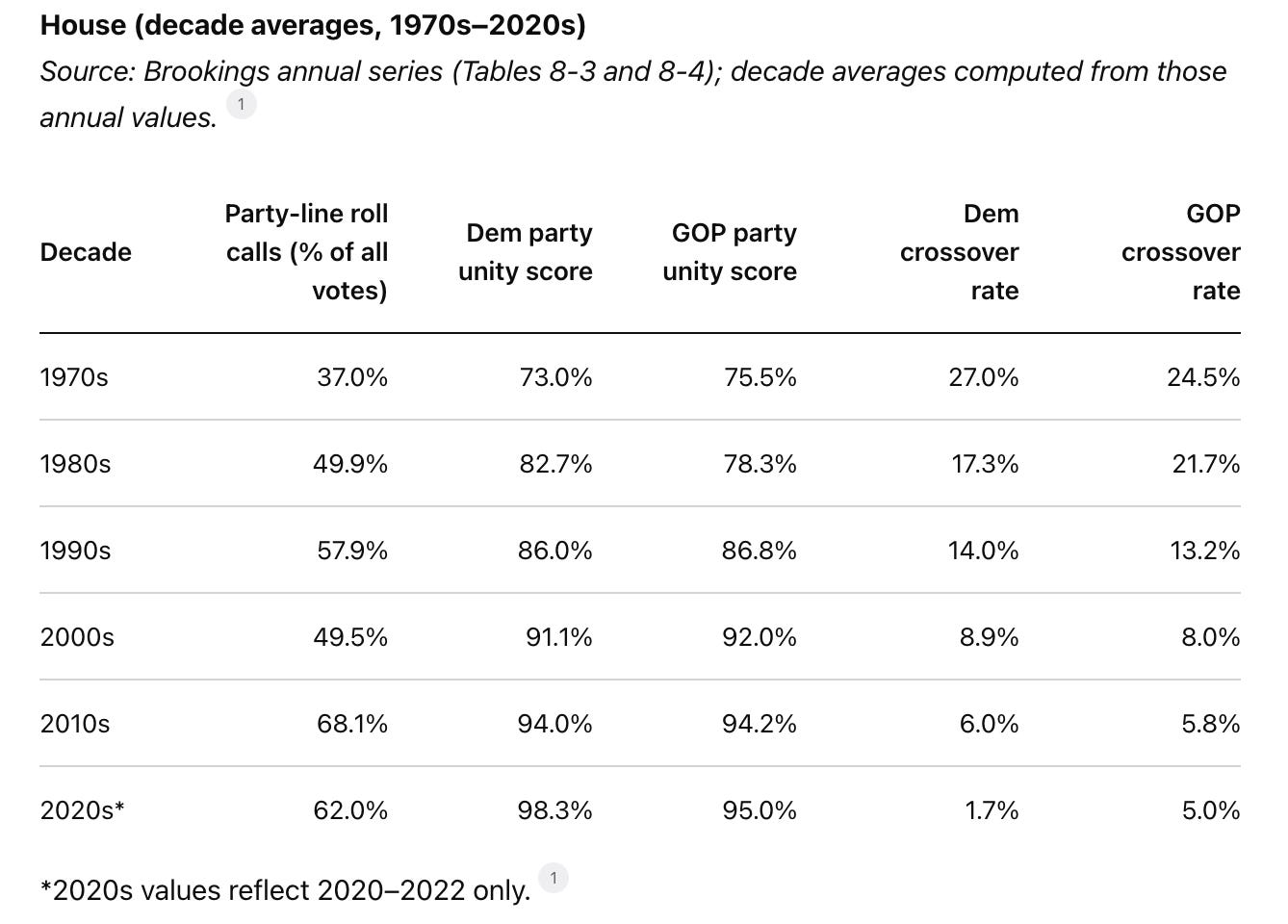
Here’s where it gets real. I computed decade averages from the Brookings annual data, and the trend line is a gut punch.
House of Representatives — Decade Averages (1970s–2020s)
Senate — Decade Averages (1970s–2020s)
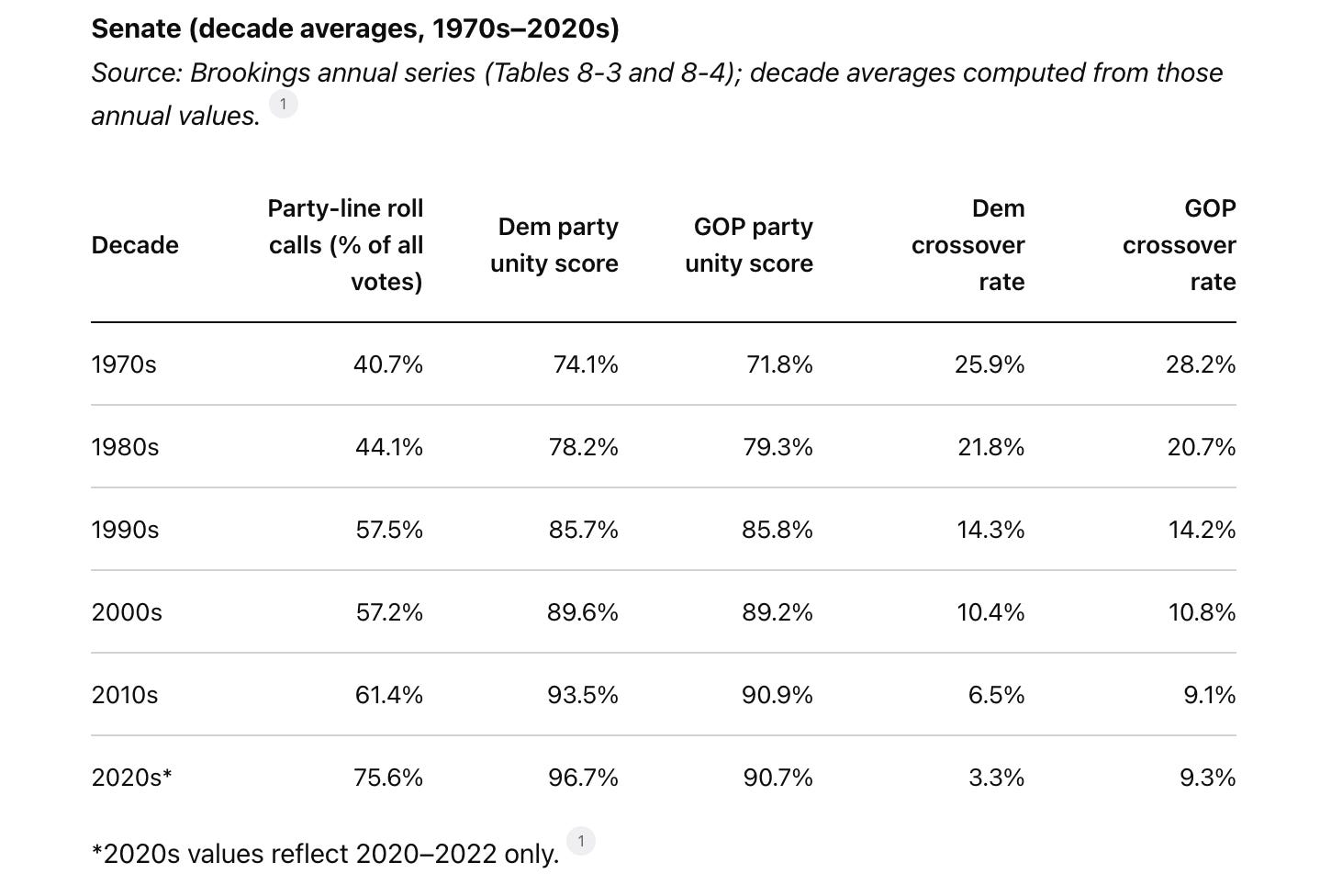
Read that bottom row one more time.
In the partial 2020s, three-quarters of Senate recorded votes were party-line. Senate Democrats crossed over just 3.3% of the time. House Democrats? 1.7%. That’s not “sticking together.” That’s a system where deviation is functionally eliminated.
In mom terms: we used to run carpools with multiple families. Now everyone insists on driving their own car — then complains about traffic.
When Was the U.S. Last “Truly Bipartisan”?
